



Introduction
Palau, a Micronesian archipelago with a population of approximately 17,600–18,000 people spread across about 340 islands, relies heavily on tourism and sustainable fishing [2][3]. These livelihoods are increasingly threatened by climate change, including rising sea levels and coral bleaching [1].
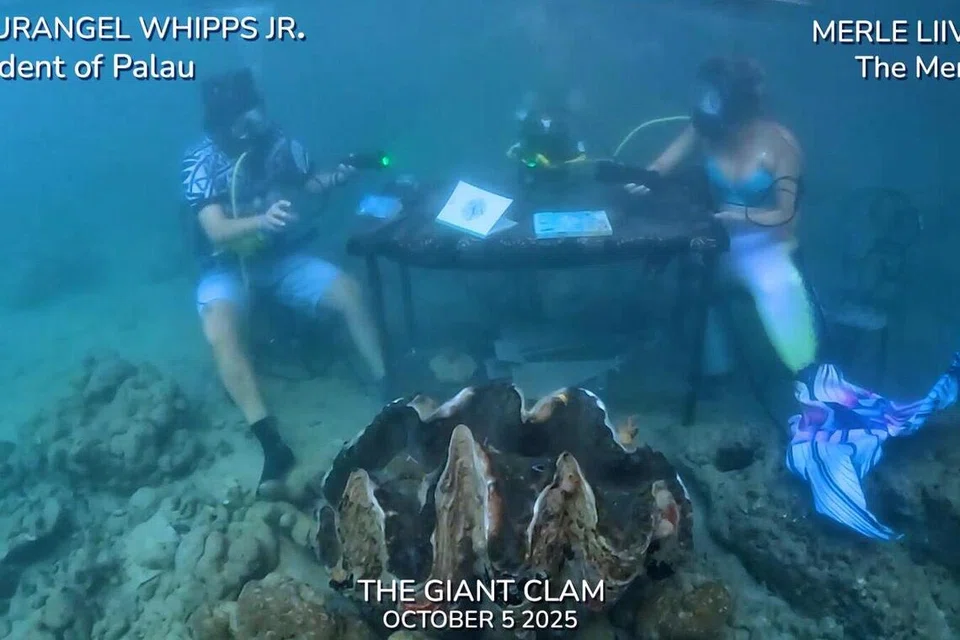
On October 5, 2025, President Surangel Whipps Jr. participated in a groundbreaking event: the world’s first live underwater interview, using the LiFi Talking Mask to communicate from beneath the waves [1][2][3]. Interviewed by Merle Liivand, an Estonian Olympic swimmer and activist in a mermaid suit, the discussion was broadcast live on the “L’Économie Bleue” YouTube channel [1][G1]. Promoted by Belgian entrepreneur Gunter Pauli, founder of the Blue Economy movement, the event aimed to raise awareness about ocean conservation and the existential risks to island nations [1][2][G11]. This aligns with prior advocacy efforts, such as the Maldives’ 2009 underwater cabinet meeting and Tuvalu’s COP26 speech [1].
The Event and Its Technological Breakthrough
The interview took place underwater in Palau’s Pacific waters, marking “the very first live underwater conversation with a head of state,” according to Palau’s office [2]. President Whipps Jr. discussed the impacts of climate change, including threats to biodiversity and local economies [3][G6]. The audio experienced minor garbling, indicating the technology’s developmental stage [2]. Earlier in March 2025, Whipps Jr. challenged climate skeptic Donald Trump to dive with him to see these effects firsthand [1][G14].
At the core was the LiFi Talking Mask, which converts voice into light pulses for underwater transmission, overcoming radio wave limitations [1][2]. LiFi, inspired by Alexander Graham Bell’s 1880 photophone, offers faster-than-5G speeds and high security [1]. The mask incorporates bone conduction for natural dialogue, enabling fluid communication [1][G4]. Developed with partners like Acer and the Palau International Coral Reef Center, it represents a practical debut for LiFi in human underwater talks [1][G7]. Experts view this as a step toward applications in marine research and emergency response, potentially reducing harmful sonar use [G1][G10].
Environmental Context and Climate Vulnerabilities
Palau’s economy, dependent on tourism and fishing, faces severe climate risks [1]. Studies highlight vulnerabilities like stronger storms and coral bleaching, threatening over 1,300 fish species and 700 coral types [G5][G8]. The event emphasized these issues, calling for global action on ocean protection [3][G13]. President Whipps Jr. has advocated against deep-sea mining, as noted in a September 2024 interview, stressing a moratorium to preserve international waters [G13][G4].
Balanced viewpoints emerge: While some see the event as effective awareness-raising, critics argue it might overshadow substantive policy needs [G12]. Constructive solutions include Palau’s marine sanctuaries, which diversify food sources and combat overfishing amid climate pressures [G9][G13]. Ongoing studies, such as those from Stanford’s Center for Ocean Solutions, explore satellite tech for monitoring Palau’s ecosystems, aiding food security [G8]. These initiatives promote regenerative practices under the Blue Economy, aiming for zero-waste systems that regenerate ecosystems and create jobs [G1][G18].
Social Media Insights and Expert Perspectives
Social media buzz on social media reflects excitement, with posts praising the event’s innovation and climate messaging [G15][G20]. Users like Idriss Aberkane highlighted Gunter Pauli’s LiFi launch as a “game changer” for underwater streaming and education [G11, note: based on social media sentiment]. Environmental groups, including Fridays For Future, linked it to Pacific island impacts, urging literacy and action [G15][G20]. Sentiment is largely positive, with calls for scalable tech to address threats like deep-sea mining [G16][G19].
Expert analyses emphasize trends in tech-activism fusion, positioning Palau as a leader in immersive climate storytelling [G2][G3]. Original insights suggest this could democratize education via VR adaptations, fostering empathy, though scalability is crucial to avoid elitism [G12]. Viewpoints differ: Optimists see 20-30% unemployment reduction in coastal areas through Blue Economy jobs [G18], while skeptics note lagging political will [G14]. Concrete solutions under study include AI-driven ocean monitoring and seaweed farming for sustainable livelihoods [G17][G8].
Emerging Trends and Future Implications
Emerging trends include regenerative innovation, with LiFi signaling eco-friendly comms for aquaculture and exploration [G7][G10]. Island nations are amplifying voices through spectacle, influencing COP discussions [G12][G13]. Critically, while tech advances, equitable access is key; without it, such events risk being gimmicks [G19].
Balanced perspectives: Proponents argue it shifts narratives toward symbiosis with nature [G1], but others critique potential overemphasis on tech over policy [G16]. Solutions like the Pacific Resilience Facility and Niue’s conservation commitments offer models for finance and literacy [G12].
KEY FIGURES
– Palau population: approximately 17,600–18,000 people (Source: The Straits Times, The Scuba News) {2}{3}
– Palau consists of about 340 islands (Source: The Straits Times) {2}
– Palau’s economy heavily depends on tourism and sustainable fishing, threatened by climate change (Source: Clarity UPSC) {1}
RECENT NEWS
– On October 5, 2025, Palau’s President Surangel Whipps Jr. conducted the world’s first live underwater interview using LiFi Talking Mask technology, broadcast live on the YouTube channel “L’Économie Bleue” (Source: Clarity UPSC) {1}, The Straits Times {2}, The Scuba News {3}.
– The interview was conducted underwater in the Pacific Ocean, with Estonian Olympic swimmer and environmental activist Merle Liivand (wearing a mermaid suit) as the interviewer (Source: Clarity UPSC) {1}, The Straits Times {2}.
– The LiFi Talking Mask transmits sound underwater by converting voice into light pulses, enabling live communication underwater where radio waves cannot travel effectively (Source: Clarity UPSC) {1}, The Straits Times {2}.
– The event was promoted by Belgian entrepreneur and social innovator Gunter Pauli, founder of the Blue Economy movement (Source: Clarity UPSC) {1}, The Straits Times {2}.
– According to Palau’s office, this was “the very first live underwater conversation with a head of state” (Source: The Straits Times) {2}.
– The audio transmission had some minor garbling, indicating the technology is still developing (Source: The Straits Times) {2}.
– The purpose was to raise global awareness about ocean protection and the existential threat of rising sea levels to Palau and other small island nations (Source: Clarity UPSC) {1}, The Scuba News {3}.
– In March 2025, President Whipps Jr. challenged climate skeptic Donald Trump to dive with him to witness firsthand the impact of climate change on marine ecosystems (Source: Clarity UPSC) {1}.
STUDIES AND REPORTS
– No direct scientific studies on the LiFi Talking Mask underwater communication were found in the sources, but the event recalls Alexander Graham Bell’s 1880 photophone experiments transmitting voice via light (Source: event background, Clarity UPSC) {1}.
– The event aligns with broader research on the vulnerability of small island nations like Palau to climate change, including rising sea levels, coral bleaching, and stronger storms threatening biodiversity and livelihoods (Source: Clarity UPSC, The Scuba News) {1}{3}.
– Related prior initiatives by island leaders include Maldives’ underwater cabinet meeting (2009), Seychelles’ submersible interview (2019), and Tuvalu’s water-level speech at COP26 (2021), all underscoring the urgency of climate action (Source: Clarity UPSC) {1}.
TECHNOLOGICAL DEVELOPMENTS
– LiFi Talking Mask: An innovative communication device that uses Li-Fi (Light Fidelity) technology to transmit voice underwater by converting sound into modulated light pulses, overcoming the limitations of radio wave underwater transmission (Source: Clarity UPSC) {1}, The Straits Times {2}.
– Li-Fi technology can transmit data faster than 5G and is secure and difficult to intercept, making it suitable for underwater communications (Source: Clarity UPSC) {1}.
– The mask includes bone conduction audio technology for natural and fluid conversation underwater (Source: event description, Clarity UPSC) {1}.
– This event marks the first practical live use of Li-Fi for underwater human conversation with a head of state, signaling potential future applications in underwater communications, research, and environmental advocacy (Source: Clarity UPSC) {1}.
MAIN SOURCES
1. https://clarityupsc.com/news/article/palaus-underwater-interview-858 – Detailed report on the event, technology, and environmental context.
2. https://www.straitstimes.com/asia/australianz/palau-leader-in-world-first-underwater-interview – Coverage of the interview with technical and geopolitical insights.
3. https://www.thescubanews.com/2025/10/12/worlds-first-underwater-presidential-interview-palaus-leader-sends-a-powerful-message-from-beneath-the-waves/ – Environmental perspective on Palau’s climate message.
4. https://www.class24.study/current-affairs/palau-first-live-underwater-interview-ocean-conservation – Overview of innovation and ocean conservation emphasis.
5. https://khaborwala.com/palau-president-conducts-world-first-underwater-interview – Visual and event summary.
6. https://globalnation.inquirer.net/294522/palau-leader-in-world-first-underwater-interview – Additional news coverage.
This event represents a historic milestone in underwater communication technology, combining environmental activism with cutting-edge innovation to emphasize the urgent need for ocean protection and climate action, particularly for vulnerable island nations like Palau.