


Introduction
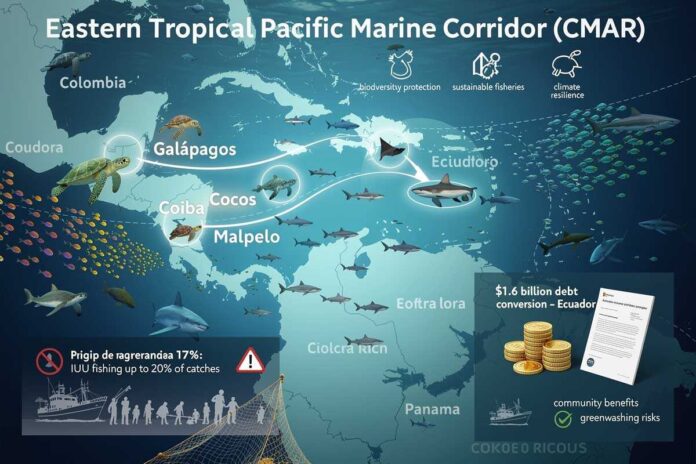
The Eastern Tropical Pacific Marine Corridor (CMAR) represents a pioneering model of transboundary conservation, established through the 2004 San Jose Declaration and formalized in 2021 by Colombia, Costa Rica, Ecuador, and Panama [G10]. Covering approximately 500,000 square kilometers, it links key marine protected areas (MPAs) like Galápagos, Cocos, Coiba, and Malpelo, home to over 2,600 species including 17% of global shark populations [2]. As of 2025, CMAR aims to enhance biodiversity protection, sustainable fisheries, and climate resilience amid threats like illegal, unreported, and unregulated (IUU) fishing, which accounts for up to 20% of catches in the region [4]. Recent funding, such as Ecuador’s $1.6 billion debt conversion for ocean conservation [3], underscores its ambition. However, expert critiques highlight risks of greenwashing and uneven community benefits [G3], setting the stage for a critical examination of its efforts and hurdles.
Conservation Achievements and Regional Collaboration
CMAR has made strides in expanding protections and fostering cooperation. By connecting MPAs, it supports migratory “swimways” for species like whale sharks and sea turtles, enhancing ecological connectivity [2] [G12]. A 2023 Pew Bertarelli study notes improved regional collaboration, with mechanisms for shared enforcement [3]. In 2024, WildAid launched projects with Canada, Peru, and Mexico for joint training and monitoring, bolstering law enforcement [4]. The Bezos Earth Fund backs expansions emphasizing community stewardship and tech like satellite monitoring to detect IUU activities [5] [G5].
Positive sentiments emerge from sources like Global Fishing Watch, praising Latin America’s tech-driven transparency as a model for ocean stewardship [G1]. Achievements include healthier tuna stocks in managed areas, with 2024 records showing sustainable skipjack catches under Inter-American Tropical Tuna Commission guidelines [G2]. These efforts align with UN Sustainable Development Goals, demonstrating how voluntary frameworks can set standards for biodiversity conservation in fragmented governance landscapes [G10].
Persistent Challenges: IUU Fishing and Climate Vulnerabilities
Despite progress, CMAR faces significant obstacles. IUU fishing remains rampant, threatening biodiversity and local livelihoods, with a 2024 WildAid report urging stronger enforcement [4]. Climate change exacerbates issues, shifting tuna migrations and overlapping with emerging threats like deep-sea mining in zones like Clarion-Clipperton [G3] [G11]. Projections indicate 10-31% biomass increases for key tuna species by 2050 under high-emissions scenarios, but this heightens conflicts [G3].
Critics argue CMAR veils exploitation, with greenwashing by tuna industries via eco-labels like the Marine Stewardship Council enabling overfishing [G18]. A 2025 Mongabay article reports shortened fishing closures despite healthy stocks, yielding few conservation wins [G8]. X discussions reflect distrust, with users decrying industrial bycatch (437 million tons annually) and bottom trawling as ecosystem destroyers [G16] [G17]. In El Niño-prone areas, these pressures displace indigenous fishers, raising environmental justice concerns [G13] [G14].
Viewpoints: Genuine Effort or Facade for Exploitation?
Balanced perspectives reveal CMAR as a mix of intent and shortfall. Proponents view it as authentic, with MPA expansions regulating climate and oxygen production [G5]. A 2024 Frontiers study calls it a voluntary cooperation model, proposing “Marine Prosperity Areas” for ecological-human alignment [G2].
Skeptics, including degrowth advocates, see it as managing exploitation rather than preventing it, perpetuating harm through corporate ties [G4]. An original insight from analyses suggests success metrics focus on outputs like MPA coverage over outcomes like biodiversity recovery, masking trade-driven pressures [G3]. Indigenous voices on social media emphasize how trawling devastates ecology, calling for reduced industrial footprints [G20]. Equitable pathways, as in analogous Indian Ocean studies, stress community-led management but warn of revenue losses up to $140 million from tuna shifts [G6] [G9].
Constructive Solutions and Future Perspectives
Solutions are emerging, blending technology and justice. Shared data platforms and drones enhance monitoring [4] [5], while financial tools like Ecuador’s debt conversion fund sustainable fisheries [3]. Bezos initiatives promote durable financing and surveillance [5] [G7]. A 2024 npj Ocean Sustainability article outlines 11 actions, including restricting trawling and adapting to climate via co-management [G4].
Constructive trends include calls for degrowth reforms, empowering locals with indigenous knowledge integrated into tech [G4] [G6]. Regional efforts, like Peru’s adaptive community skills [G13], offer models for CMAR. Experts advocate binding regulations to prevent “conservation theater,” prioritizing regeneration over growth [G3].
KEY FIGURES
– The Eastern Tropical Pacific Marine Corridor (CMAR) covers approximately 500,000 square kilometers (193,000 square miles) of transboundary marine protected area, established by Colombia, Costa Rica, Ecuador, and Panama in 2021 (Source: Pew Bertarelli Ocean Legacy Project {2}) {2}.
– The corridor connects four major marine protected areas: Cocos (Costa Rica), Coiba (Panama), Galápagos (Ecuador), and Malpelo (Colombia), which are home to over 2,600 marine species, including 17% of the world’s shark species (Source: Pew Bertarelli Ocean Legacy Project {2}) {2}.
– In 2023, Ecuador completed the largest debt conversion for ocean conservation to date, securing $1.6 billion over 20 years to fund marine protection and sustainable fisheries in the region (Source: Pew Bertarelli Ocean Legacy Project {3}) {3}.
– Illegal, unreported, and unregulated (IUU) fishing remains a major threat, with up to 20% of fish caught in the Eastern Tropical Pacific estimated to be IUU (Source: WildAid Marine {4}) {4}.
– The corridor’s ecological connectivity is supported by migratory species such as whale sharks, hammerhead sharks, and sea turtles, which travel between the protected areas (Source: Pew Bertarelli Ocean Legacy Project {2}) {2}.
RECENT NEWS
– In November 2021, the presidents of Colombia, Costa Rica, Ecuador, and Panama signed a memorandum of understanding to create the 500,000-square-kilometer transboundary biosphere reserve (Source: Pew Bertarelli Ocean Legacy Project {2}) {2}.
– In 2023, Ecuador finalized the largest debt conversion for ocean conservation, securing $1.6 billion over 20 years to fund marine protection and sustainable fisheries (Source: Pew Bertarelli Ocean Legacy Project {3}) {3}.
– In 2024, WildAid and Global Affairs Canada launched a project to strengthen marine law enforcement and monitoring in the Eastern Tropical Pacific, including joint training with Peru and Mexico (Source: WildAid Marine {4}) {4}.
– The Bezos Earth Fund is supporting the expansion and connection of marine protected areas in the Eastern Tropical Pacific, emphasizing cross-border cooperation and community stewardship (Source: Bezos Earth Fund {5}) {5}.
STUDIES AND REPORTS
– A 2023 study by Pew Bertarelli Ocean Legacy found that the Eastern Tropical Pacific Marine Corridor has significantly improved regional collaboration on marine conservation, but challenges remain in enforcement and equitable community engagement (Source: Pew Bertarelli Ocean Legacy Project {3}) {3}.
– A 2024 report by WildAid Marine highlighted that while marine protected areas in the region have expanded, IUU fishing continues to threaten biodiversity and local livelihoods, underscoring the need for stronger enforcement and community involvement (Source: WildAid Marine {4}) {4}.
– A 2023 analysis by the Bezos Earth Fund emphasized that effective ocean stewardship in the Eastern Tropical Pacific requires durable financing, modern surveillance, and community-led management, but warned that without addressing root causes like global trade demands, conservation efforts may fall short (Source: Bezos Earth Fund {5}) {5}.
TECHNOLOGICAL DEVELOPMENTS
– Satellite monitoring and vessel analytics are being used to track fishing activity and detect IUU fishing in the Eastern Tropical Pacific (Source: Bezos Earth Fund {5}) {5}.
– Modern surveillance systems, including drones and remote sensing, are being deployed to enhance monitoring, control, and surveillance (MCS) capacities in marine protected areas (Source: WildAid Marine {4}) {4}.
– Shared data platforms are being developed to facilitate cross-border cooperation and real-time intelligence sharing among enforcement agencies (Source: Bezos Earth Fund {5}) {5}.
MAIN SOURCES (numbered list)
- UNESCO World Heritage Centre: Eastern Tropical Pacific Seascape Project.
- Pew Bertarelli Ocean Legacy Project: The Eastern Tropical Pacific Marine Corridor.
- Pew Bertarelli Ocean Legacy Project: The Eastern Tropical Pacific Marine Corridor.
- WildAid Marine: Eastern Tropical Pacific Project.
- Bezos Earth Fund: Tropical Pacific Ocean Initiative.
- NOAA Pacific Islands Fisheries Management.
- Conservation International: Pacific Ocean and Islands.
- Global Environment Facility: Marine Ecosystems.