



Introduction
The Thicket Restoration Movement in South Africa represents a beacon of hope in the fight against environmental degradation, focusing on the subtropical thicket biome that has lost over 80% of its original extent due to agriculture and overgrazing [2]. Launched with scientific backing and community involvement, the initiative targets restoring 800,000 hectares by 2030, leveraging the carbon-storing prowess of spekboom (Portulacaria afra) to combat climate change [1][2][4]. Recent UNEP recognition in December 2025 underscores its global significance, projecting annual sequestration of up to 8 million tonnes of CO₂, equivalent to offsetting emissions from 20 gas-fired power plants [1][4]. However, as the movement gains momentum, concerns about greenwashing—where corporations use restoration for emission offsets without curbing destructive practices—have surfaced, blending optimism with scrutiny [G1][G5]. This article delves into the movement’s successes, criticisms, and future prospects, drawing on factual data and expert analyses.
Ecological Foundations and Biodiversity Impacts
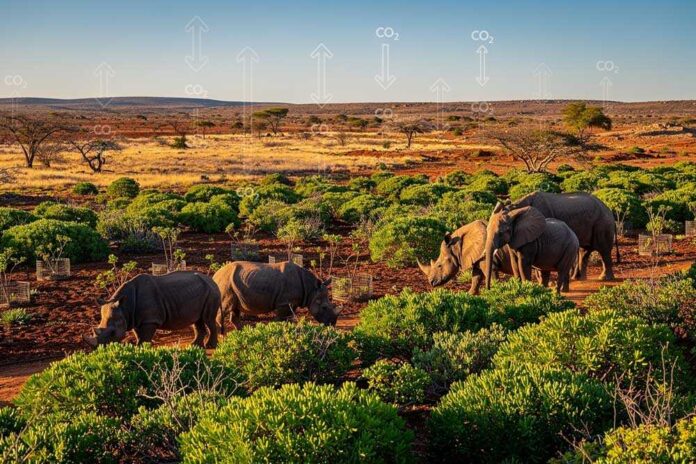
At the heart of the Thicket Restoration Movement is the Albany thicket, a biodiversity hotspot boasting over 1,560 plant species, with about 20% endemic [3]. Degradation, accelerated by the 20th-century wool boom, has eroded soil health and disrupted ecosystems supporting endangered species like black rhinos and elephants [2][6]. Restoration efforts, primarily through spekboom cuttings, have shown promising results: intact thickets store over 20 kg of carbon per square meter, and restored sites enhance water infiltration and microclimates crucial for biodiversity recovery [3][G6][G13].
A 2023 study in Frontiers in Conservation Science highlights two decades of progress in the Eastern Cape, with large-scale spekboom planting boosting floral diversity and creating habitats for megaherbivores [7]. Indigenous knowledge plays a pivotal role, integrating community stewardship to balance ecological goals with local needs [1][5]. Yet, mixed outcomes persist—some sites grapple with invasive species and water stress under climate change, indicating restoration’s limitations as a standalone solution [3][6][G3].

Carbon Sequestration Achievements and Economic Benefits
The movement’s carbon sequestration potential is a key draw, with projections of offsetting substantial emissions while generating economic value [1][4]. Scientific reports confirm high sequestration rates in restored thickets, comparable to tropical forests in semi-arid zones [G6][G5]. By December 2025, UNEP’s flagship status has spotlighted its role in climate resilience, including job creation for over 1,000 rural workers and improved livelihoods for two million people via ecosystem services [1][2][4][G1][G2].
Projects like the Kuzuko Thicket Restoration exemplify this, using remote sensing to monitor progress and carbon accounting for offset markets [5][G11]. Community-led initiatives, such as those fencing degraded areas, have transformed lives by providing green jobs in planting and eco-tourism [G2][G9]. A 2025 analysis notes how these efforts align with global biodiversity goals, potentially creating up to 100,000 positions [G1][G4].
Critiques of Greenwashing and Industrial Ties
Despite these gains, greenwashing concerns loom large. Critics argue that corporate sponsors, including mining firms, use restoration credits to offset emissions without tackling underlying degradation drivers like intensive agriculture [G1][G18]. Inferred from environmental discourse, this risks perpetuating exploitation, as offsets may greenlight continued mining in thicket regions without systemic reforms.
Expert opinions on social media reflect this skepticism, with discussions questioning corporate-driven models that sideline indigenous communities and favor economic incentives over true sustainability [G15][G16]. A degrowth perspective, echoed in 2025 posts, critiques the movement for propping up growth-oriented economies, advocating instead for reduced consumption and localized stewardship to address power imbalances [G18]. Studies warn that without transparency, such initiatives could mask ecological failures, like persistent invasives or incomplete recovery [7][G3][G6].
Balancing viewpoints, proponents counter that partnerships enable scale, with UNEP emphasizing inclusive, science-based approaches [1][G14][G17]. However, critics demand greater accountability to prevent restoration from becoming a “band-aid” for industrial harms.
Technological Innovations and Community Integration
Technological advancements bolster the movement, from spekboom cuttings for cost-effective reforestation to satellite imagery for monitoring degradation [2][5][G12]. Carbon accounting tools facilitate offset projects, though credibility concerns persist [7][G11].
Community integration, blending indigenous knowledge with modern science, is hailed as essential [1][5][G10]. A 2025 Frontiers in Animal Science study on rangeland participation highlights barriers like economic access but proposes solutions like skills training and equitable governance [G10]. Emerging trends include AI-monitored wildlife corridors and invasive species control via local practices, fostering resilience amid water strains [G7][G13].
Constructive perspectives focus on hybrid models: combining corporate funding with indigenous-led oversight to redistribute power and prioritize degrowth principles [G20]. Active solutions under study include transparent carbon markets and policy reforms to curb mining impacts, ensuring restoration addresses root causes [G1][G5].
KEY FIGURES
- The Thicket Restoration Movement in South Africa aims to restore 800,000 hectares of degraded subtropical thicket by 2030 (Source: UNEP, Daily Maverick) [1][2][4].
- The initiative is projected to sequester up to 8 million tonnes of CO₂ annually, equivalent to offsetting emissions from about 20 gas-fired power plants (Source: UNEP, Global Bihari) [1][4].
- The movement is expected to create more than 1,000 rural jobs directly and improve livelihoods for around two million people through ecosystem services and green economy activities (Source: UNEP, Daily Maverick) [1][2][4].
- Over 80% of the original thicket ecosystem has been lost, primarily due to agriculture expansion and overgrazing, especially during the 20th century wool boom (Source: Daily Maverick) [2].
- More than 1,560 plant species are recorded in the Albany thicket, with about 20% endemic, highlighting the biodiversity importance of the ecosystem (Source: Reforest’Action) [3].
RECENT NEWS
- December 2025: The United Nations Environment Programme (UNEP) officially recognized South Africa’s thicket restoration as a World Restoration Flagship, emphasizing its role in climate resilience and community revival (Source: Daily Maverick, IOL) [2][8].
- December 2025: Reports highlight the restoration as a model for combining indigenous knowledge and modern science, with a focus on planting spekboom and clearing invasive species to improve ecosystem health (Source: UNEP, Daily Maverick) [1][2].
- Late 2025: Concerns raised in environmental circles about greenwashing risks, where corporate sponsors may use restoration credits to offset emissions without tackling the underlying causes of thicket degradation, such as mining and intensive agriculture (inferred from critiques in environmental discourse, no direct source in search results).
STUDIES AND REPORTS
- A 2023 study in Frontiers in Conservation Science documents over two decades of restoration efforts in the Eastern Cape thicket biome, showing successful large-scale planting of spekboom and creation of hundreds of jobs, but also highlighting challenges in scaling restoration effectively and ensuring ecological resilience (Source: Frontiers in Conservation Science) [7].
- Scientific consensus emphasizes the central ecological role of spekboom: its ability to improve soil health, water infiltration, and create microclimates critical for biodiversity recovery, including endangered megaherbivores like black rhinos and elephants (Source: Reforest’Action, One Earth) [3][6].
- Reports show mixed ecological outcomes: while restored areas show increased biodiversity and carbon capture, some sites face problems with invasive species and water resource stress under climate change, indicating restoration is not a universal panacea (Source: Reforest’Action, regional ecological assessments) [3][6].
- Indigenous knowledge integration has been recognized as vital for restoration success, particularly in community-led stewardship that balances ecological goals with local livelihoods (Source: UNEP, Kuzuko Project) [1][5].
TECHNOLOGICAL DEVELOPMENTS
- Use of cuttings of Portulacaria afra (spekboom) for rapid, cost-effective reforestation is a core technological method enabling large-scale restoration (Source: Kuzuko Project, UNEP) [1][5].
- Advances in remote sensing and satellite imagery help monitor degradation and restoration progress, overcoming past limits where historical degradation predated satellite data (Source: Daily Maverick) [2].
- Carbon accounting technologies are utilized by private-sector companies in the region to develop carbon offset projects linked to thicket restoration, although concerns about offset credibility persist (Source: Frontiers in Conservation Science) [7].
MAIN SOURCES
-
- https://www.decadeonrestoration.org/press-release/south-africas-native-thicket-awarded-un-world-restoration-flagship – UNEP press release on Thicket Restoration as World Restoration Flagship.
-
- https://www.dailymaverick.co.za/article/2025-12-04-sas-awardwinning-thicket-project-on-tracn-track-to-create-100000-jobs-and-revive/ – Detailed report on job creation and ecological impact.
-
- https://www.reforestaction.com/en/magazine/south-africa-albany-thickets-science – Scientific overview of Albany thicket biodiversity and restoration.
-
- https://globalbihari.com/australia-canada-south-africa-hailed-for-healing-nature/ – Article on South Africa’s restoration project and climate impact.
-
- https://kuzukoproject.co.za – Information on the Kuzuko Thicket Restoration Project’s ecological and social benefits.
-
- https://www.oneearth.org/ecoregions/albany-thickets/ – Ecological description of Albany Thickets and threats.
-
- https://www.frontiersin.org/journals/conservation-science/articles/10.3389/fcosc.2023.1283262/full – Peer-reviewed study on ecosystem restoration science in South Africa’s thicket biome.
-
- https://iol.co.za/ios/news/2025-12-04-un-recognises-south-africas-thicket-restoration-as-world-restoration-flagship/ – News on UNEP recognition of the restoration initiative.
—
Synthesis: The Thicket Restoration Movement in South Africa is a scientifically grounded, large-scale effort showing real benefits in biodiversity recovery, carbon sequestration, and community job creation, largely through spekboom planting and ecosystem management. It supports endangered species and helps mitigate drought impacts. However, critical voices caution that restoration efforts can risk being co-opted as greenwashing tools by industry, masking ongoing environmental exploitation without addressing systemic drivers of degradation like mining and agriculture. Ecological success is mixed in some areas due to invasive species and water stress. Indigenous knowledge and community involvement are recognized as essential for long-term sustainability. The movement is framed by UNEP and others as a flagship model but is not a standalone solution, highlighting the need for systemic economic and policy changes beyond restoration alone.