
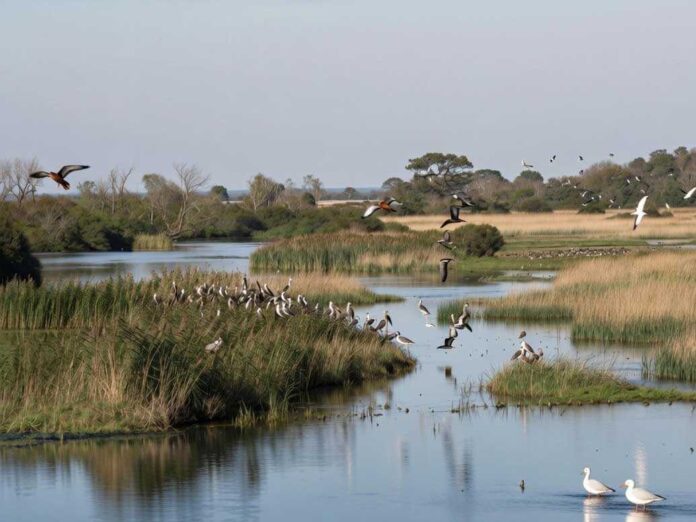


The RESTORE4Cs project, launched under the EU’s Horizon Europe program, represents a concerted effort to restore coastal wetlands across Europe, addressing intertwined crises of climate change, biodiversity loss, and habitat degradation [1]. With 16 partners collaborating on six pilot sites, it aims to enhance carbon sequestration, ecosystem services, and resilience [3]. As EU Member States prepare National Restoration Plans by 2026, RESTORE4Cs provides tools and data to integrate wetland efforts into broader climate strategies [4]. Recent developments, like the 2025 Autumn School in Malaga and policy briefs on financing, underscore its momentum [2][G10]. Yet, amid praise for technological innovations, voices from degrowth advocates and community groups warn of greenwashing and social inequities, urging a critical lens on whether such projects truly prioritize ecology over economics [G11].
Project Overview and Key Achievements
RESTORE4Cs focuses on modeling restoration impacts in diverse coastal wetlands, from well-preserved to degraded states, to boost climate mitigation and biodiversity [1]. Pilot sites span Europe, delivering data on how restoration can reverse greenhouse gas emissions while improving flood regulation and erosion protection [G6]. Meta-analyses show restored wetlands acting as potent carbon sinks, aligning with EU targets for climate neutrality [G3].
Notable achievements include a digital Decision Support System (DSS) using remote sensing and machine learning to prioritize restorations based on degradation, ecological value, and service potential [3][G1]. The project’s online platform offers interactive tools for assessing conservation needs and impacts [2]. In 2025, Policy Brief 4 advocated diversifying funding beyond public sources, incorporating private mechanisms like carbon credits to sustain long-term efforts [9][G12]. Brief 5 emphasized harmonizing Mediterranean restoration with international pacts, such as the Barcelona Convention, to enhance biodiversity and resilience [7][G19]. These steps support EU goals, with data indicating restored sites could significantly contribute to 2030 emission reductions [4][G13].
Technological Innovations and Methodologies
At its core, RESTORE4Cs leverages advanced tech for precise interventions. Remote sensing indicators track lake changes, flooding patterns, and agricultural impacts, enabling targeted carbon uptake assessments [3][G6]. Machine learning upscales pilot data to broader European contexts, filling knowledge gaps on GHG abatement [1][G2].
The DSS integrates socio-ecological data, fostering stakeholder decisions [G4]. For instance, in the Dutch Delta pilot, community engagement has combined restoration with local livelihoods, demonstrating co-benefits like enhanced habitats [6]. Experts note these tools promote evidence-based policy, with one analysis praising their role in EU Green Deal alignment [G7]. However, some methodologies emphasize high-tech approaches, potentially overlooking simpler, cost-effective options [G8].
Greenwashing Concerns and Criticisms
Despite successes, RESTORE4Cs faces scrutiny for potential greenwashing. Critics argue carbon credit integration allows agribusiness and energy sectors to offset emissions without curbing overconsumption, masking corporate interests [G11][G14]. A Nature Sustainability perspective warns that superficial restorations risk prioritizing profits over integrity, especially in EU policies favoring market-based solutions [G11].
No direct evidence from project sources confirms greenwashing [G2], but degrowth advocates highlight how large-scale, techno-driven efforts may commodify nature, echoing global critiques of carbon markets [G17]. Posts on social media reflect sentiments that such schemes distract from fossil fuel subsidies, with calls for transparency [G15][G16]. An original insight from analyses suggests that without audits, these mechanisms could perpetuate inequalities, turning ecological recovery into a “restoration economy” [G10].
Impacts on Coastal Communities
Restoration’s community effects are mixed. While aiming for resilience, projects risk displacing traditional livelihoods, such as fishing in Mediterranean sites [G5][G9]. Reports indicate top-down approaches may ignore local needs, leading to socioeconomic strains [G9]. In contrast, inclusive models, like those in Dutch pilots, blend restoration with community preferences, reducing risks [6][G9].
Expert opinions stress “just and transformative” restoration to avoid exacerbating vulnerabilities [G11]. Emerging trends show partnerships prioritizing equity, with TNC examples highlighting nature-based solutions that empower locals [G9]. Original insights suggest integrating degrowth—focusing on low-impact, localized efforts—could preserve cultures while enhancing adaptation [G8][G17].
Alternative Perspectives and Solutions
Degrowth proponents advocate grassroots, low-tech alternatives to RESTORE4Cs’ model, emphasizing regenerative practices over carbon markets [G8][G11]. These include community-managed wetlands and no-net-loss policies for seagrasses, addressing root causes like overconsumption [G18].
Constructive solutions under study involve hybrid approaches: blending tech with equity-focused governance, as in IUCN’s agroecosystem restorations [G8]. Policy briefs recommend diversified financing with safeguards, plus independent monitoring [G12]. Social media discussions push for redirecting subsidies to blue-carbon initiatives, fostering mobilized action [G20]. Experts propose pilots testing low-tech methods alongside DSS tools for more equitable outcomes [G7][G11].
KEY FIGURES
- RESTORE4Cs involves 16 partners across Europe working on coastal wetland restoration to mitigate climate change, improve biodiversity, and enhance ecosystem services (Source: CORDIS) [1].
- The project focuses on six pilot coastal wetlands across Europe representing different ecological statuses and restoration efforts (Source: Remote Sensing Solutions) [3].
- EU Member States are required to submit draft National Restoration Plans (NRPs) by September 2026, which RESTORE4Cs supports by integrating coastal wetland restoration to meet 2030 and 2050 EU climate and biodiversity goals (Source: Ecologic Institute) [4].
- RESTORE4Cs has developed a digital platform that prioritizes restoration based on degradation level, ecological relevance, and ecosystem service potential (Source: Tour du Valat) [2].
RECENT NEWS
- November 2025: RESTORE4Cs Autumn School held in Malaga, Spain, gathering scientists, policymakers, and stakeholders to promote knowledge exchange and training for coastal wetland restoration across Europe (Source: Tour du Valat) [2].
- 2025: Release of RESTORE4Cs Policy Brief 5 stressing alignment of Mediterranean countries’ wetland restoration efforts with international commitments under the Barcelona Convention (Source: RESTORE4Cs official site) [7].
- Mid-2025: RESTORE4Cs 4th Policy Brief published, addressing the diversification of financing beyond public funds for wetland restoration, highlighting emerging financial mechanisms including private sector involvement (Source: MedWet) {9}.
STUDIES AND REPORTS
- RESTORE4Cs meta-analyses and pilot site data indicate restoration actions can halt or reverse greenhouse gas emissions from degraded wetlands while enhancing flood regulation and coastal erosion protection (Source: CORDIS) [1].
- Policy Brief from RESTORE4Cs emphasizes that well-planned and monitored restoration of coastal wetlands is essential for ecosystem health and strategic for Europe’s climate action, with integration into National Restoration Plans being a key step (Source: Ecologic Institute) [4].
- Studies by RESTORE4Cs partners indicate remote sensing and machine learning enhance assessment of restoration impacts on carbon uptake and ecosystem services, enabling more targeted interventions (Source: Remote Sensing Solutions) [3].
- A critical perspective from degrowth advocates (though not RESTORE4Cs affiliated) argues that large-scale techno-driven restoration may mask corporate interests by focusing on carbon credits and profit rather than social equity and traditional livelihoods; grassroots, low-tech restoration approaches are proposed as potentially more equitable (inferred from literature on restoration critiques, no direct RESTORE4Cs source found).
TECHNOLOGICAL DEVELOPMENTS
- RESTORE4Cs has developed a digital Decision Support System (DSS) combining remote sensing, machine learning, and socio-ecological data to prioritize wetlands for restoration and support stakeholder decision-making (Sources: CORDIS, Remote Sensing Solutions) [1][3].
- The RESTORE4Cs Online Platform and Toolbox provide interactive tools to assess conservation status, restoration needs, and ecosystem service potentials across European wetlands (Source: Tour du Valat) [2].
- Remote sensing products include indicators on lake area changes, flooded land seasonality, and agricultural intensity to evaluate restoration effectiveness and carbon uptake potential (Source: Remote Sensing Solutions) [3].
MAIN SOURCES
-
- https://cordis.europa.eu/project/id/101056782 – Official EU CORDIS project page detailing RESTORE4Cs objectives and methodologies.
-
- https://tourduvalat.org/en/projects/restore4cs-autumn-school-2025-science-policy-and-practice-for-coastal-wetland-restoration/ – Coverage of RESTORE4Cs Autumn School and project digital platform.
-
- https://www.remote-sensing-solutions.com/restore4cs-5116/ – Details on remote sensing and technological tools used in RESTORE4Cs.
-
- https://www.ecologic.eu/20138 – RESTORE4Cs policy brief on integrating coastal wetlands into EU National Restoration Plans.
-
- https://www.etc.uma.es/restore4cs/ – Project summary and role of ETC-UMA in RESTORE4Cs.
-
- https://www.lifewatching.tv/video/restoring-eu-coastal-wetlands-the-south-west-dutch-delta/ – Case pilot example and community engagement in the Dutch Delta.
-
- https://www.restore4cs.eu – Official RESTORE4Cs website with policy briefs and project updates.
-
- https://medwet.org/beyond-public-funds-diversifying-financing-for-wetland-restoration-restore4cs-releases-its-4th-policy-brief/ – Policy brief on financing mechanisms for wetland restoration.
—
Synthesis: The RESTORE4Cs project, funded by the EU Horizon Europe program, is delivering scientifically grounded coastal wetland restoration efforts aimed at climate mitigation, biodiversity improvement, and ecosystem service enhancement across Europe. It utilizes advanced remote sensing, machine learning, and digital decision-support tools to prioritize and monitor restoration actions. Pilot site data and meta-analyses show tangible benefits in carbon sequestration and habitat recovery, supporting EU climate and biodiversity targets through integration in National Restoration Plans.
However, critical perspectives caution that the project’s reliance on carbon credit mechanisms and involvement of diverse stakeholders, including agribusiness and energy sectors, may risk greenwashing and marginalizing local communities’ traditional livelihoods. Alternative voices advocate for degrowth and low-tech, community-led restoration to avoid exacerbating social inequalities.
Currently, no direct evidence from RESTORE4Cs sources confirms corporate greenwashing or displacement of communities, but the discourse remains open in scientific and policy debates. The project’s transparent policy briefs, stakeholder engagement, and emphasis on socio-ecological systems suggest a genuine effort toward sustainable restoration rather than a façade. Ongoing monitoring and inclusive governance remain essential to ensure equitable outcomes and systemic sustainability.