



Introduction
The Andean forests of Junín, Peru, stand as critical sentinels in the fight against environmental degradation, yet they face unprecedented threats from human activity and climate change. This region, part of the high Andes, has endured severe forest loss, with more than 16,000 hectares affected by man-made fires in recent years, primarily from agricultural burning and grassland management [1]. These fires not only ravage biodiversity but also accelerate soil erosion, water pollution, and glacier retreat—issues that compound the Andes’ staggering 95% loss of native forests and up to 50% of its glaciers [4]. Amid this crisis, restoration projects are emerging as vital countermeasures, emphasizing water security, community empowerment, and ecological recovery.
Why does this matter now? In 2025, as the UN Decade on Ecosystem Restoration (2021-2030) gains momentum, Acción Andina has been spotlighted as a flagship initiative, with plans to restore 1 million hectares across six countries by 2045, including significant efforts in Peru [2]. Recent data from Junín highlights the urgency: proposals to protect 60,000 hectares in areas like San Cristóbal de Pucutá – Menkori underscore the need for legal safeguards against further destruction [1]. This article delves into the facts, drawing on verified research and real-time social media insights from X (formerly Twitter), to analyze restoration’s progress, challenges, and potential. By integrating expert opinions and community sentiments, it presents a balanced view, highlighting constructive solutions to combat pollution and foster sustainable paths forward.
The Devastation: Forest Fires and Ecosystem Loss in Junín
Junín’s high Andean landscapes, characterized by Polylepis woodlands—ancient, high-altitude trees adapted to extreme conditions—have been profoundly altered by anthropogenic pressures. The Junín Region Forest Fire Disaster Risk Prevention and Reduction Plan (2024–2030) reveals that most fires are man-made, stemming from traditional practices like burning grass for agriculture, which have scorched over 16,000 hectares [1]. This destruction is not isolated; it mirrors broader Andean trends where deforestation and climate change have led to a 95% reduction in native forests, severely impacting carbon storage, biodiversity, and water regulation [4]. Pollution from these fires releases particulate matter and greenhouse gases, exacerbating air quality issues and contributing to glacial melt, which has halved the region’s ice cover [4].
Studies underscore the human cost: a January 2025 analysis in People and Nature identifies water scarcity for agriculture as the primary driver behind reforestation motivations in Peru’s Andes, with secondary benefits including improved livelihoods and community well-being [5]. In areas like San Cristóbal de Pucutá – Menkori, unregulated burning has degraded ecosystems, prompting proposals for a Regional Conservation Area (RCA) to legally protect 60,000 hectares [1]. Social media echoes this concern; X users highlight the link between forest loss and water insecurity, with one post noting how degraded forests in Junín fail to recharge aquifers, leading to erosion and reduced climate resilience[1]. Experts on social media also stress the pollution angle, pointing out how fire-induced smog affects downstream communities, amplifying health risks in already vulnerable highland populations.
Critically, while fires are often intentional for land clearance, they spiral into uncontrolled disasters due to changing weather patterns. The Adaptation Fund proposal for Peru’s high Andes emphasizes how such events disrupt water regulation, polluting rivers with sediment and ash [7]. Balancing views, some agricultural stakeholders argue that controlled burns are culturally embedded and necessary for pasture renewal, but reports counter that without alternatives, these practices perpetuate a cycle of degradation [1]. The stakes are high: unchecked pollution from fires threatens not only local ecosystems but also global carbon balances, making Junín a microcosm of Andean vulnerability.
Restoration Initiatives: Acción Andina and Local Projects
Against this backdrop, Acción Andina emerges as a beacon of proactive restoration, recognized by the UN in February 2025 as a flagship for the Decade on Ecosystem Restoration [2]. Launched in 2018, the initiative has restored nearly 5,000 hectares and protected over 11,250 hectares of Andean forests, planting almost 12 million trees across Peru and five other countries [2]. In Junín, efforts focus on Polylepis species, which are essential for soil stabilization and water retention. By the end of 2024, partners planted 579,306 trees in 11 projects, with a 2025 annual report projecting Phase 2 (2025–2030) to scale up for enhanced water security [4].
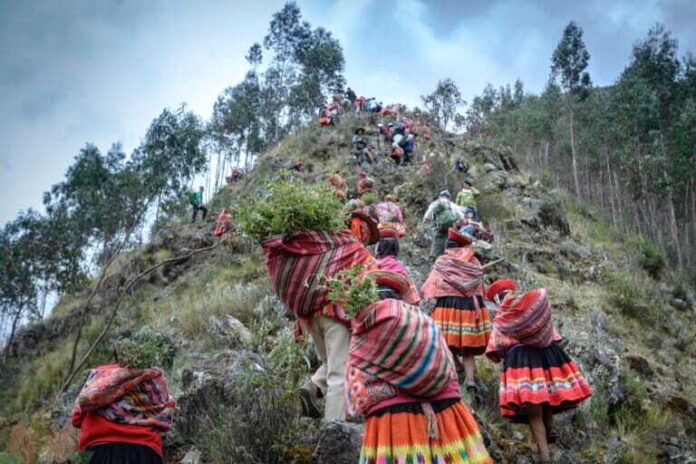
A standout example is the Acquia district, where 275 hectares of Polylepis woodlands have been restored as of 2024, involving over 650,000 trees [3]. On December 7, 2024, communities achieved a remarkable feat: planting 150,000 native trees in one day, building on collaborations with ECOAN and Acción Andina [3]. This mass planting not only combats pollution by enhancing carbon sequestration but also restores habitats for endemic species. Further afield in Challabamba, Peru, over 350,000 native plants were planted by May 2024, with an additional 115,000 trees by January 2025, demonstrating scalable models [5].
Recent news amplifies these successes: in 2025, Global Forest Generation’s report highlights Acción Andina’s socio-economic impact, where every US$1 invested yields US$3.53 in social value through jobs and ecosystem services [4]. X sentiment reflects optimism; posts from environmental organizations celebrate large-scale restorations in regions including Junín, Áncash, Lima, and Pasco, targeting over 44,000 hectares[2]. Expert opinions on social media emphasize how these projects integrate with national strategies, such as MINAM’s ecosystem restoration in high Andean protected areas[3]. However, balanced analysis reveals limitations: not all plantings achieve high survival rates due to harsh altitudes, prompting calls for adaptive monitoring [3].

Community Involvement and Traditional Knowledge
Central to Junín’s restoration is the fusion of indigenous practices with scientific approaches, fostering inclusive solutions. In San Cristóbal de Pucutá – Menkori, over 60 community members were trained in forest fire prevention under the 2024–2030 plan, equipping them to safeguard proposed RCA zones [1]. This training addresses pollution at its source by promoting alternatives to burning, while empowering locals through knowledge transfer.
Traditional ecological knowledge, such as mink’a (communal work) and siembra y cosecha de agua (water sowing and harvesting), plays a pivotal role. In Acquia, these methods have ensured long-term success in Polylepis restoration, enhancing water infiltration and reducing erosion [3]. The Yunkawasi Peru initiative in Pucutá-Menkori similarly leverages community-led reforestation for climate resilience [6]. A 2025 study confirms that motivations stem from practical needs like agricultural water, with communities viewing restoration as a pathway to well-being [5].
X users share positive sentiments, with posts illustrating how communal efforts in Junín generate employment and strengthen resilience[1]. Experts on the platform advocate for renaturalization over simplistic reforestation, emphasizing native species and ecosystem dynamics[4][5]. Critically, while community involvement boosts success rates, challenges persist: unequal access to training can marginalize women and remote groups, necessitating broader inclusion [5]. Solutions lie in scaling microenterprises, like queuña nurseries and solar panels, to sustain participation [2].
Technological and Economic Innovations
Innovation underpins Junín’s restoration, blending technology with economic incentives to combat pollution. Acción Andina supports community microenterprises, including nurseries for native queuña trees, efficient clay stoves to reduce fuelwood demand, and solar panels for sustainable energy [2]. These reduce reliance on destructive practices, curbing emissions and deforestation.
Economic analyses reveal compelling returns: the aforementioned US$3.53 social value per dollar invested underscores restoration’s viability [4]. In broader Andean contexts, technologies like water systems enhance siembra y cosecha de agua, improving infiltration and aquifer recharge [3]. The Adaptation Fund proposal integrates these for high-Andes water regulation, addressing pollution from erosion [7].
Social media insights show enthusiasm for such integrations; X posts discuss seed-launching techniques for diverse ecosystems, adaptable to Junín’s challenges[5]. However, critics note that technology alone isn’t sufficient without policy support—funding gaps could hinder scaling [4]. Actionable paths include public-private partnerships to expand microenterprises, ensuring economic benefits flow to pollution-affected communities.
Challenges and Balanced Perspectives
Despite progress, hurdles remain. Survival rates in high-altitude restorations can dip below 50% due to drought and grazing, as noted in long-term studies [3]. Pollution from ongoing fires continues to undermine efforts, with man-made blazes outpacing prevention [1]. Economically, while investments yield returns, initial costs deter smallholders [4].
Balanced views from X reveal mixed sentiments: while many praise community-driven successes, some highlight the need for ecosystem-specific approaches to avoid misguided plantings[4][5]. Experts warn against over-optimism, advocating for monitoring to counter climate variability [5]. Constructive solutions include enhanced legal protections, like the RCA proposal, and international funding to bridge gaps [1][7].
Conclusion
Junín’s Andean forest restoration exemplifies a committed response to environmental peril, weaving data-driven initiatives with community resolve to heal polluted landscapes. From Acción Andina’s ambitious goals to local feats like Acquia’s mass plantings, these efforts secure water, biodiversity, and livelihoods amid global warming’s toll [2][3][4]. Yet, challenges demand vigilance—integrating traditional knowledge, technology, and policy to ensure sustainability.
Looking ahead, scaling to 1 million hectares by 2045 offers a replicable model, but success hinges on collective action: governments must enforce fire prevention, donors fund inclusive projects, and communities lead with indigenous wisdom [2][1]. Readers can support by engaging with organizations like Global Forest Generation or advocating for policies that prioritize high-Andes protection. In fighting pollution and restoring these vital ecosystems, Junín charts a path toward a resilient future— one tree, one community at a time.
Key Figures
- More than 16,000 hectares affected by man-made forest fires in Junín in recent years[1].
- San Cristóbal de Pucutá – Menkori RCA proposal to legally protect around 60,000 hectares in Junín[1].
- By 2045, Acción Andina aims to restore 1 million hectares of Andean forests across six countries, including Peru[2].
- Since 2018, Acción Andina has restored nearly 5,000 hectares and protected more than 11,250 hectares of Andean forests, planting nearly 12 million trees[2].
- In Acquia district (Peru Andes), 275 hectares of Polylepis woodlands restored as of 2024, with over 650,000 trees planted[3].
- 150,000 native trees planted in a single day by communities in Acquia on December 7, 2024[3].
- By end of 2024, Acción Andina partners planted 579,306 trees across 11 projects[4].
- Andes has lost 95% of its native forests and up to 50% of its glaciers[4].
- Over 350,000 native plants planted as of May 2024, and 115,000 native trees as of January 2025 in Challabamba, Peru (Andean reforestation)[5].
Recent News
- High Andean communities in Junín’s San Cristóbal de Pucutá – Menkori RCA trained in forest fire prevention, equipping over 60 people (2024-2025 context via 2024–2030 Plan)[1].
- Acción Andina recognized by UN as flagship for Decade on Ecosystem Restoration (2021-2030), with 25 projects in high-altitude Polylepis forests including Peru (February 2025)[2].
- Communities in Acquia planted 150,000 trees in one day, building on ECOAN and Acción Andina efforts (December 7, 2024)[3].
- Global Forest Generation 2025 Annual Report on scaling Acción Andina Phase 2 (2025–2030) for Andean restoration, focusing water security (2025)[4].
Studies And Reports
- Junín Region Forest Fire Disaster Risk Prevention and Reduction Plan (2024–2030): Most fires man-made from grass burning and agriculture, affecting >16,000 ha[1].
- People and Nature study (January 2025): Primary motivation for Andean reforestation in Peru is water for agriculture; secondary include livelihoods and community well-being[5].
- Acción Andina societal-economic analysis: US$1 invested generates US$3.53 in social value[4].


