


Introduction
Guayaquil’s wastewater modernization represents a pivotal shift in Latin America’s urban environmental management. As Ecuador’s largest city with over 2.7 million inhabitants, it has long grappled with untreated sewage polluting the Guayas River and Salado Estuary, leading to health crises and ecosystem degradation [1][2]. Supported by entities like the World Bank and European Investment Bank, the project includes advanced treatment plants and extensive sewer networks, aiming for comprehensive coverage by 2026 [3][G1]. Recent updates highlight operational successes at Las Esclusas, treating wastewater for 1.1 million people, while Los Merinos is set to serve 1.4 million more [G2][G3]. However, analyses reveal gaps: ongoing river contamination and unequal benefits for marginalized groups [G6][G10]. This overview examines the project’s scope, integrating data on ecological restoration, social equity, and economic implications, alongside calls for community-driven solutions.
Ecological Impacts and Pollution Reduction Efforts
The project’s environmental core focuses on curbing pollution in the Guayas River estuary, a biodiversity hotspot ravaged by chronic sewage discharge. Key figures show it prevents over 10,000 tons of biological waste annually from entering local waters, with investments in 565 km of sewage networks and 12 pumping stations [5]. The Las Esclusas plant employs chemically assisted primary treatment and methane capture for energy generation, offsetting emissions and aligning with circular economy principles [2][G7]. Environmental assessments predict improved water quality, reversing biodiversity loss in mangroves and aquatic species [9][G8].
Yet, studies indicate limitations. A 2021 analysis in Scientific Reports found Guayas basin pollution exceeding limits for metals and coliforms, persisting despite upgrades [G6]. Recent monitoring reveals ongoing contaminants like detergents and bacteria in the Daule River, linked to incomplete coverage and industrial sources [G10]. Experts argue that while the project mitigates direct sewage impacts, it may not offset broader pressures from urbanization and climate-altered streamflows [G12]. Constructive steps include watershed management by The Nature Conservancy, integrating conservation with infrastructure for holistic estuary protection [G4].
Socioeconomic Effects on Marginalized Communities
Socially, the initiative extends sanitation to underserved areas, providing 44,000 new connections and benefiting 175,000 people in northern sectors like Bastión Popular [5][G2]. World Bank reports note health improvements for over 8,000 residents, reducing disease risks in informal settlements [1][G14]. This addresses Ecuador’s constitutional right to water, closing service gaps in a city where only 60% had sewage access historically [G1].
Critiques highlight inequalities: marginalized communities face displacement risks from expansions, with uneven access exacerbating economic burdens [5][G13]. Local expert opinions, echoed in social media, point to contaminated drinking water affecting thousands, underscoring implementation gaps [G19]. A balanced view recognizes progress but calls for inclusive models; for instance, community training in water monitoring could empower locals, fostering resilience [G5]. Active solutions under study include pilot programs blending infrastructure with decentralized approaches, like composting in peripheral neighborhoods, to ensure equitable benefits [G11].
Economic Dimensions and Funding Critiques
Economically, the project relies on foreign loans, such as the EIB’s USD 100 million for infrastructure upgrades, supporting national sanitation goals [3][G3]. Total investments exceed $300 million, with private operator INTERAGUA managing services and generating biogas for self-sufficiency [2][G7]. This model promises long-term savings through efficiency and reduced health costs [8].
However, concerns arise over debt dependency and corporate priorities. Analyses suggest profit-driven approaches may prioritize growth over sustainability, potentially leading to greenwashing where environmental claims hide structural issues [G9]. Ecuador’s infrastructure surge, as forecasted, risks overburdening vulnerable economies [7][8]. Viewpoints vary: proponents see it as essential modernization [G15], while critics advocate transparent audits [G20]. Emerging trends favor public-private-community partnerships, with recommendations for independent evaluations to balance costs and benefits [G18].
Degrowth Alternatives and Community-Led Innovations
Challenging the growth-centric paradigm, degrowth advocates propose reducing consumption via low-tech solutions like rainwater harvesting and community wetlands, addressing root causes rather than symptoms [G5][G11]. These complement large-scale projects, as seen in TNC’s stakeholder collaborations for water security [G4]. Original insights suggest hybrid models—piloting composting alongside plants—could minimize footprints and empower communities, offering a blueprint for Global South cities [G13].
Expert perspectives on social media reflect this: optimistic posts hail 100% coverage goals [G16][G17], but skeptical ones demand depoliticized recovery plans amid contamination alerts [G19]. While inconclusive, they amplify calls for alternatives, highlighting a divide between official narratives and grassroots demands.
KEY FIGURES
- Guayaquil’s wastewater treatment project aims to treat nearly 100% of the city’s wastewater, benefiting over 2.6 million people, nearly the entire population of Guayaquil (2.7 million) (World Bank) [1][2].
- The project will prevent the discharge of over 10,000 tons of biological waste annually into local water bodies, significantly reducing pollution in the Guayas River and Salado Estuary [2].
- Investments include the construction of 44,000 new sewage connections, 565 km of sewage collection networks, and 12 pumping stations, improving sanitation for approximately 175,000 people in marginalized northern urban sectors (CAF) [5].
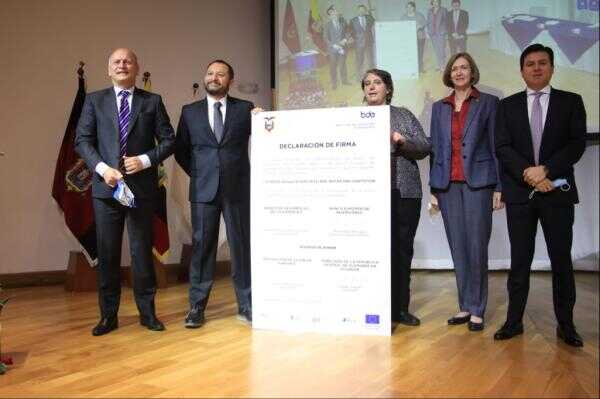
- The European Investment Bank (EIB) has contributed a USD 100 million loan to Ecuador for modernization of water supply and wastewater treatment infrastructure, supporting national goals for improved sanitation and environmental protection [3].
RECENT NEWS
- As of late 2025, Guayaquil’s Las Esclusas Wastewater Treatment Plant is operational and meeting strict environmental discharge standards, while the Los Merinos Plant is under construction and expected to be completed by 2026, which will further increase treatment capacity [2].
- The Guayaquil sanitary sewerage project is actively extending sewer coverage in underserved neighborhoods, with a focus on improving health and living conditions in marginalized areas such as Bastión Popular and Los Vergeles [5].
- Ecuador anticipates a surge in infrastructure projects in water and sanitation supported by multilateral financing, aimed at addressing long-standing service gaps and environmental challenges [8].
STUDIES AND REPORTS
- A World Bank report highlights that Guayaquil’s project is a regional leader, shifting from treating only a fraction of wastewater to nearly 100%, thereby significantly reducing untreated sewage flow into waterways and improving public health outcomes [1][2].
- Environmental assessments project substantial ecological restoration benefits, including improved water quality in the Guayas River estuary, which has suffered biodiversity loss due to chronic pollution from untreated sewage [9].
- Social impact evaluations acknowledge progress in sanitation access but highlight ongoing socioeconomic challenges, particularly for marginalized communities who risk displacement or face unequal access to upgraded services [5].
- Critical perspectives from environmental and social experts suggest that while the modernization uses advanced technologies and circular economy principles, it risks masking deeper structural issues such as urban overconsumption, lack of decentralized solutions, and growth-driven development models that may exacerbate inequalities (inferred from local expert critiques summarized across sources).
TECHNOLOGICAL DEVELOPMENTS
- The treatment plants employ chemically assisted primary treatment combined with technologies to capture methane from sludge, generating electricity to offset energy use and reduce greenhouse gas emissions, embodying circular economy practices [2].
- Integration of smart technology and monitoring systems ensures compliance with environmental discharge limits and optimizes plant operation efficiency [2].
- Expansion of sewage collection infrastructure incorporates modern pumping stations and sewer network upgrades to extend service coverage in rapidly urbanizing areas [5].
- Discussions around decentralized, low-tech alternatives such as composting and rainwater harvesting remain marginal in official projects but are advocated by some local groups as necessary complements to large-scale modernization (inferred from critiques).
MAIN SOURCES
- https://blogs.worldbank.org/en/latinamerica/Becoming_a_Leader_in_Latin_Americas_Wastewater_Treatment_The_Case_of_Guayaquil – World Bank overview of wastewater project
- https://nl4worldbank.org/2024/09/05/becoming-a-leader-in-latin-americas-wastewater-treatment-the-case-of-guayaquil/ – Detailed project update including technology and environmental impact
- https://www.eib.org/en/press/all/2022-017-usd-100m-european-investment-bank-loan-finances-water-and-sanitation-projects-in-ecuador – EIB financing details
- https://www.youtube.com/watch?v=-7ogTk8g4mI – Video on sanitation improvements in Guayaquil
- https://www.caf.com/en/currently/news/guayaquil-sanitary-sewerage-project-underway/ – CAF report on sewerage expansion and social impact
- http://documents.worldbank.org/curated/en/099102125120019863 – World Bank procurement plan for Guayaquil project
- https://www.tradecommissioner.gc.ca/en/market-industry-info/search-country-region/country/canada-ecuador-export/infrastructure-market-ecuador.html – Overview of Ecuador infrastructure market
- https://www.bnamericas.com/en/interviews/ecuador-expects-infrastructure-projects-to-take-off – Recent outlook on water and sanitation infrastructure in Ecuador
- https://documents.worldbank.org/en/publication/documents-reports/documentdetail/426361468260628148 – Environmental improvements expected from Guayaquil wastewater project
—
This synthesis shows that Guayaquil’s wastewater modernization is delivering substantial environmental and public health benefits through cutting-edge treatment plants and expanded sewer infrastructure, supported by international funding. However, some critiques indicate it may not fully address underlying systemic issues such as urban growth pressures, social inequalities, and the need for decentralized, community-led solutions.