



Introduction
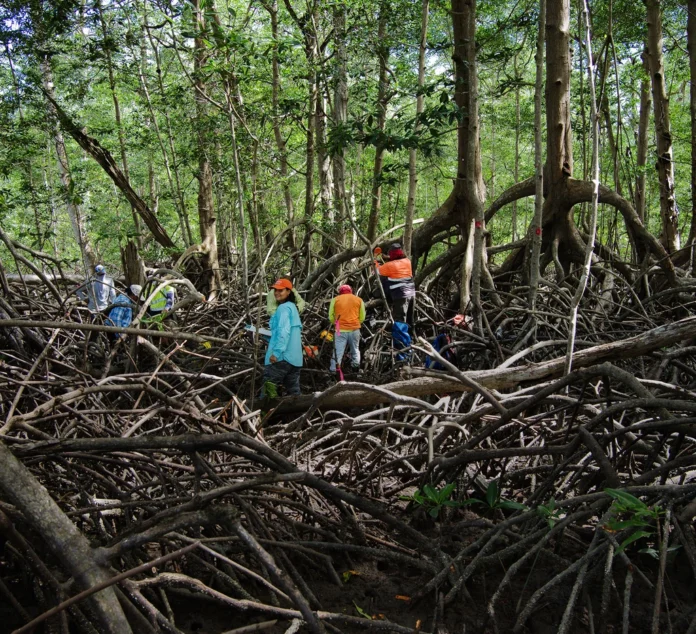
Panama boasts approximately 161,000 hectares of mangroves as of 2020, but has lost 20-25% since the 1960s due to urbanization, shrimp farming, and infrastructure development [1]. These ecosystems are powerhouses for blue carbon, storing 800-1,200 tons of CO₂e per hectare in areas like Panama Bay and Parita Bay [1]. Recent initiatives, such as the Audubon Americas and Inter-American Development Bank (IDB) project, aim to generate Panama’s first blue carbon credits, potentially offsetting hundreds of thousands of tons of CO₂e over 30 years [1]. Meanwhile, regional efforts like the Adaptation Fund proposal for Bocas del Toro emphasize nature-based solutions (NbS) for coastal resilience [3]. However, expert analyses warn of greenwashing, where corporate-driven carbon schemes might exploit indigenous groups like the Guna Yala, displacing communities while claiming ecological wins [G2], [G11]. This section overviews the interplay of restoration goals, factual data, and critical perspectives.
Ecological Impacts and Blue Carbon Potential
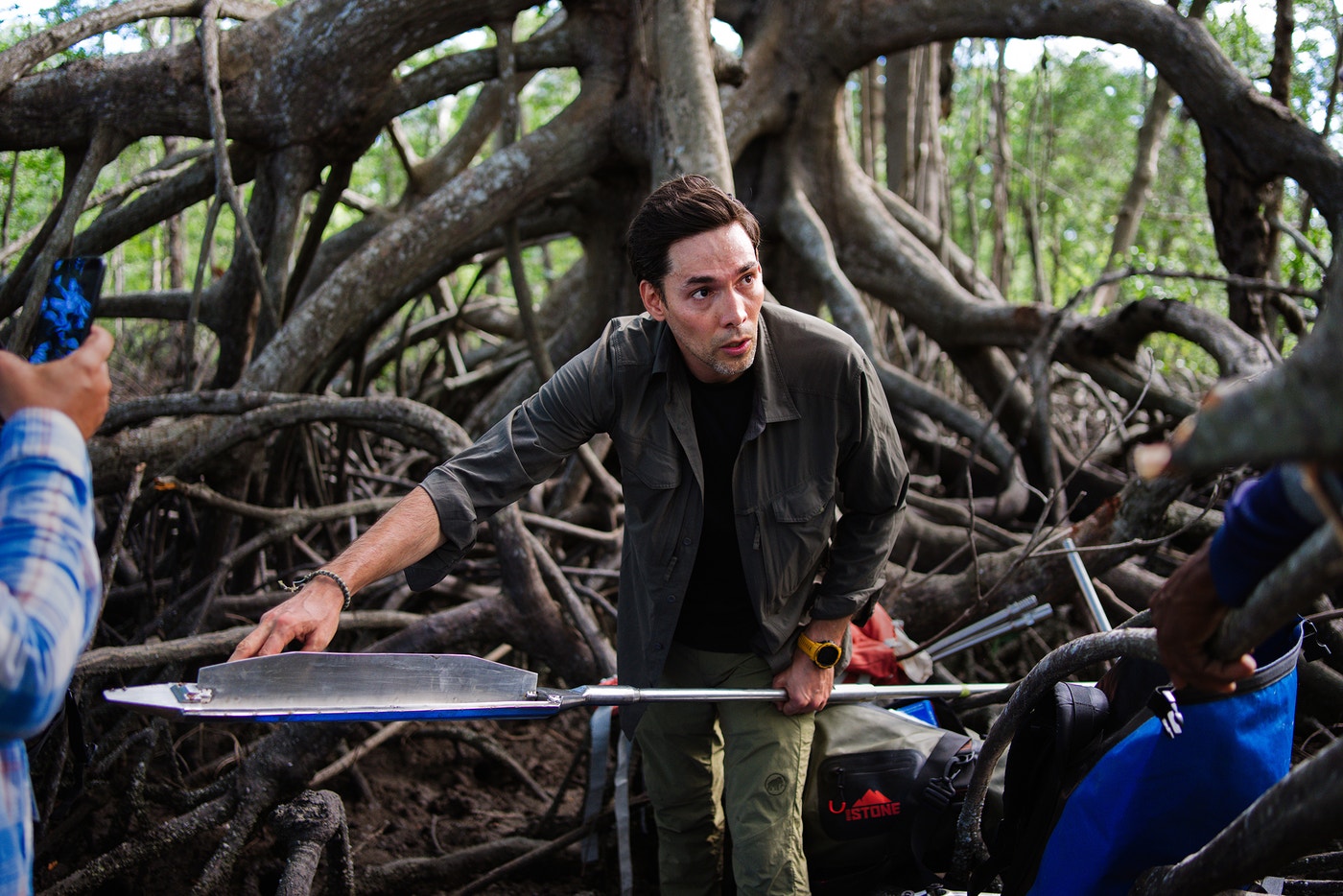
Mangroves in Panama provide essential services, from carbon sequestration to biodiversity hotspots. Field assessments in Panama Bay and Parita Bay reveal high carbon densities in soils, supporting fish nurseries and migratory birds, while underscoring the need for protection against development pressures [1]. The UNESCO regional project (2022-2025) positions mangrove restoration as an NbS in biosphere reserves, integrating local knowledge for climate adaptation [2]. Globally, syntheses like those from the Global Mangrove Alliance cite Panama as a case for linking restoration to climate finance [4].
Expert views highlight wins in fisheries and storm protection. Restored mangroves boost yields by 20-30% in similar regional studies, countering biodiversity loss amid climate stressors like sea-level rise [G1], [G5]. A 2023 review emphasizes their role in reducing wave impacts, offering cost-effective alternatives to hard infrastructure [G5]. However, unintended issues persist: invasive species introduction during large-scale projects could disrupt native ecosystems [G7]. From a degrowth lens, these efforts challenge endless extraction but risk creating “ecological debt” if offsets fail to address broader deforestation [G14].
Balanced viewpoints emerge from recent trends. Web reports on the Mangrove Breakthrough at COP30 (2025) note scaling finance for restorations, with Panama highlighted for collaborative models [from web results]. Yet, X posts reflect sentiments on mangroves’ carbon efficiency, warning of failures without adaptive strategies against rising seas [from X results].
Socio-Economic Challenges and Community Involvement
Panama’s initiatives involve significant community engagement, reaching 21,300 students by 2022 and consulting artisanal fishers and locals [1]. The Adaptation Fund proposal integrates NbS with livelihoods in tourism and fisheries, arguing for lower-cost risk management [3]. UNESCO’s project trains youth as bridges between communities and managers, emphasizing co-management with Indigenous Peoples and Local Communities (IPLCs) [2].
Critics, however, point to exploitation. In Guna Yala, top-down approaches risk displacement, with policy fragmentation sidelining local voices [G2]. Foreign investments in carbon credits attract scrutiny as potential greenwashing, enabling continued emissions elsewhere [G6]. A degrowth perspective critiques this as “carbon colonialism,” where profits overshadow equity [G11]. Studies on similar contexts, like Southeast Asia, show community-led models yield 40-50% higher success [G9].
Alternative views favor inclusivity. X discussions from 2026 highlight participatory plantings, such as 30,000 seedlings in Colombia’s akin projects, suggesting Panama adopt hybrid models [from X results]. News on Indonesia’s 21 million mangrove saplings (2024-2025) offers scalable lessons for community-driven resilience [from news results].
Technological and Policy Innovations
Technological advancements bolster Panama’s efforts. The Audubon-IDB project uses field-based carbon measurements and ecosystem modeling to establish blue carbon baselines [1]. NbS methodologies in the Adaptation Fund proposal compare restoration costs with infrastructure, aiding risk planning [3]. UNESCO promotes participatory mapping for monitoring [2].
Expert analyses advocate adaptive management to counter invasives and climate risks [G7]. Emerging trends, like 2026 Eco-Business reports on local adaptation, push for audits to prevent greenwashing [G8]. Original insights suggest hybrid funding with community governance could align with degrowth, capping corporate roles [G4].
KEY FIGURES
- Panama mangrove area and loss: Panama had about 161,000 ha of mangroves in 2020, with an estimated loss of ~20–25% since the 1960s, mainly to urbanization, shrimp farming, and infrastructure (FAO Global Forest Resources Assessment; Global Mangrove Watch, cited in UNESCO regional project docs and Audubon reporting).[1]
- Carbon storage (“blue carbon”): Mangrove soils in Panama’s Bay of Panama and Parita Bay store an estimated 800–1,200 t CO₂e per hectare in biomass and sediments, placing them among the country’s most carbon‑dense ecosystems (Audubon Americas–IDB blue carbon baseline work, 2020–2022).[1]
- Potential blue carbon credits: The Audubon/Inter‑American Development Bank project in Panama Bay and Parita Bay aims to generate Panama’s first ocean‑based (blue) carbon credits; preliminary estimates suggest a potential of hundreds of thousands of tons of CO₂e over 30 years if degradation is halted and restoration succeeds (project description and interviews).[1]
- Coastal protection / risk reduction: Regional NbS project documentation for Costa Rica–Panama notes that mangrove and coral reef restoration can reduce wave heights and coastal flooding and is cost‑effective compared with hard infrastructure, contributing directly to disaster risk reduction for coastal communities in Bocas del Toro and Limón (Adaptation Fund proposal, 2024).[3]
- Panama’s climate / conservation targets: Panama is recognized as carbon negative and has pledged to maintain at least 30% of its marine area under protection by 2030, with mangrove conservation highlighted as a key nature‑based solution in its NDC and marine protection announcements (Panama government and international NGO summaries, 2021–2023).{5}
- Community involvement scale: The Panama Audubon Society’s education and stakeholder engagement linked to mangrove conservation had reached 21,300 students in Panama Bay by 2022 and is expanding to Parita Bay, alongside consultations with artisanal fishers, ranchers and local officials to design conservation plans.[1]
RECENT NEWS
- Blue carbon groundwork in Panama Bay and Parita Bay – Audubon Americas and the Inter‑American Development Bank are conducting multi‑year field campaigns in Panama Bay and Parita Bay to quantify carbon stocks and other ecosystem services as a basis for Panama’s first mangrove blue‑carbon credit scheme, emphasizing the risk that powerful economic groups continue to push for coastal development despite the Bay’s protected status (Summer 2022, Audubon magazine).[1]
- Global mangrove finance and Panama – The Global Mangrove Alliance / Mangrove Breakthrough highlights Panama as one of the national examples where partnerships and finance mechanisms are scaling mangrove protection and restoration; Audubon Panama’s Yenifer Díaz is listed as a speaker to discuss Panama‑focused collaboration at the IUCN Congress 2025 session on transformative mangrove projects (event program, 2025).[4]
- Regional NbS project including Bocas del Toro (Panama) – An Adaptation Fund regional proposal (2024) for Costa Rica and Panama (“Enhancing the climate resilience of coastal communities in Limón and Bocas del Toro through Nature‑based Solutions”) foregrounds mangrove and coral reef restoration as key measures for storm and flood protection and livelihood resilience in Bocas del Toro, Panama.[3]
- Latin American biosphere‑reserve mangrove restoration project (includes Panama) – UNESCO launched a three‑year project (2022–2025) on “Mangrove Restoration as a Nature‑Based Solution in Biosphere Reserves in Latin America and the Caribbean,” listing Panama among the participating countries; it focuses on restoring mangroves in UNESCO biosphere reserves, community/youth engagement, and linking Indigenous and Local Communities with reserve management bodies (project description, 2022).[2]
STUDIES AND REPORTS
- Audubon Americas / IDB blue‑carbon assessment in Panama Bay and Parita Bay
– Main conclusions: Field work shows high carbon densities in mangrove soils, strong nursery function for fish and invertebrates, and critical habitat for migratory birds; the project is explicitly designed to underpin blue carbon crediting and incentivize national‑level protection of Panama’s mangrove coasts. Community participation is identified as essential to ensure benefits reach local people, and the article notes historical conflicts with developers over protected status in Panama Bay, indicating tension between conservation and economic interests.[1]
- UNESCO “Mangrove Restoration as a Nature‑Based Solution in Biosphere Reserves in Latin America and the Caribbean” (2022–2025)
– Main conclusions: The regional project (including Panama) treats mangrove restoration in biosphere reserves as a nature‑based solution to climate change, coastal protection, and biodiversity loss. It stresses co‑management with Indigenous Peoples and Local Communities (IPLCs), training youth as coordinators between technical committees and communities, and integrating local/indigenous knowledge. It frames restoration as compatible with, but not a substitute for, broader conservation and climate commitments; it does not present evidence that restoration fully offsets mangrove or forest loss elsewhere.[2]
- Adaptation Fund Regional Project Proposal: “Enhancing the climate resilience of coastal communities in Limón, Costa Rica and Bocas del Toro, Panama through Nature‑based Solutions” (2024)
– Main conclusions: Proposes mangrove and coral reef restoration combined with other ecosystem‑based measures as central to disaster risk reduction and livelihood adaptation. It argues NbS measures offer lower‑cost, longer‑term risk management than artificial coastal defenses and are consistent with national development and climate strategies. It identifies tourism, agriculture, and fisheries as key value chains to be supported but does not report on implementation outcomes yet (proposal stage).[3]
- Global / regional mangrove restoration syntheses referencing Panama
– Recent global collaborative initiatives (Global Mangrove Alliance, Mangrove Breakthrough) cite Panama among national case studies where mangrove conservation and restoration are being linked to climate finance and blue natural capital, but available program materials are largely conceptual and programmatic, not yet reporting detailed ecological monitoring results or socio‑economic outcomes specific to Panama.[4]
TECHNOLOGICAL DEVELOPMENTS
(Most recent documents discuss programmatic and methodological developments more than hardware technologies; the following are the main relevant developments referenced in current initiatives.)
- Standardized blue‑carbon measurement and accounting for Panama’s mangroves
– The Audubon–IDB project in Panama Bay and Parita Bay is applying field‑based carbon stock measurements (biomass and soil cores) and developing standardized blue‑carbon baselines to qualify for carbon crediting; this includes quantifying co‑benefits like fish nursery value and coastal protection as decision‑support metrics for government and investors.[1]
- Nature‑based solution (NbS) methodologies for disaster risk reduction
– The Adaptation Fund proposal emphasizes the use of NbS risk‑reduction methodologies that compare the effectiveness and cost of mangrove and coral reef restoration with hard infrastructure, integrating ecosystem service modeling into climate‑risk planning for Bocas del Toro, Panama.[3]
- Youth and community capacity‑building tools for co‑management
– UNESCO’s regional project is developing training courses and coordination roles (youth “bridges” between technical committees and IPLCs) and promoting the use of participatory mapping and local knowledge as operational tools to plan and monitor mangrove restoration within biosphere reserves that include Panama.[2]
MAIN SOURCES
- https://www.audubon.org/magazine/buried-treasure-panamas-mangrove-forests-carbon-they-store – Audubon magazine feature (2022) on Audubon Americas / IDB blue‑carbon project in Panama Bay and Parita Bay, describing Panama’s mangrove carbon stocks, conservation status, stakeholder engagement, and plans for blue‑carbon credits.
- https://www.unesco.org/en/articles/mangrove-restoration-nature-based-solution-biosphere-reserves-latin-america – UNESCO project page (2022–2025) on “Mangrove Restoration as a Nature‑Based Solution in Biosphere Reserves in Latin America and the Caribbean,” listing Panama as a participating country and outlining objectives and community‑engagement mechanisms.
- https://www.adaptation-fund.org/wp-content/uploads/2024/03/4_AFB.PPRC_.33.21-Proposal-for-Costa-Rica-Panama.2.pdf – Adaptation Fund regional project proposal (2024) “Enhancing the climate resilience of coastal communities in Limon, Costa Rica and Bocas del Toro, Panama through Nature-based Solutions for local livelihoods,” detailing planned mangrove and coral reef restoration and NbS approaches.
- https://iucncongress2025.org/programme/inspiring-stories-transformative-collaboration-advance-conservation-and-restoratio


