


Introduction
Indonesia, with its vast network of over 5,500 rivers, faces an environmental onslaught from plastic waste, much of which originates from urban and rural mismanagement. As someone who has mapped geological formations across continents and seen how industrial activities disrupt natural water flows, I recognize the parallels in how pollution alters river ecosystems. Sungai Watch, established in Bali in 2020, emerged as a response to this crisis, focusing on preventing plastic from reaching the oceans. By 2025, the organization had expanded to Java and beyond, employing innovative barriers to intercept waste and pioneering Sungai Design—an upcycling initiative that turns collected plastics into eco-friendly furniture and accessories. This model not only addresses immediate cleanup but promotes long-term sustainability through community involvement and economic incentives. According to their 2024 Impact Report, they’ve cleaned 380 rivers and installed 268 barriers, collecting up to 3 tons of plastic daily[1]. Recent social media buzz on social media (formerly Twitter) highlights growing public support, with users praising their real-time cleanups during floods and rainy seasons[[1]](https://x.com/i/status/2012628058524508562). However, challenges like government enforcement and scalability persist, demanding a balanced examination of their impact.
The Scale of Plastic Pollution in Indonesian Rivers
Indonesia ranks as the world’s second-largest contributor to ocean plastic pollution, with an estimated 1.29 million metric tons entering the seas annually from its rivers. This statistic isn’t abstract; it’s a geological and ecological time bomb. During my mining days, I observed how sediment runoff from extraction sites could devastate downstream habitats, much like how plastic debris accumulates in riverbeds, altering sediment layers and leaching toxins into aquifers. Rivers such as the Citarum and Brantas in Java are notorious hotspots, laden with single-use plastics that fragment into microplastics, infiltrating food chains and human health.
Sungai Watch’s data underscores this urgency. By October 2025, they reported collecting 286,014 kg of waste that year alone, across 302 locations with 4,444 volunteers[2]. Their brand audits—systematic analyses of collected waste—reveal that multinational corporations contribute significantly, providing evidence for policy advocacy. For instance, in Tabanan, Bali, 107 cleanups in 2023 removed tons of debris, leading to the conversion of an illegal landfill into a sunflower garden[1]. Yet, broader studies, including those from the World Bank, indicate that without systemic changes, river pollution could double by 2030 due to population growth and inadequate waste infrastructure.
Critically, while Sungai Watch’s efforts are commendable, they address symptoms rather than roots. Experts on social media have pointed out interconnected issues like deforestation exacerbating floods that carry more plastic into rivers[[2]](https://x.com/i/status/2023678767198052827). A post from environmental account @volcaholic1 in December 2025 highlighted how logging in Sumatra worsens river flooding, implicating companies in ecosystem damage[[3]](https://x.com/i/status/1996287306685358584). This balanced view reminds us that cleanup alone isn’t enough; it must pair with reforestation and stricter regulations.
Origins and Operations of Sungai Watch
Sungai Watch began as a grassroots movement by brothers Gary and Sam Bencheghib, inspired by their river expeditions revealing Bali’s polluted waterways. By 2024, it had grown into a formidable operation with 170 full-time “River Warriors”—local Indonesians trained in waste collection and monitoring[2]. Their model is straightforward yet effective: deploy floating barriers to trap trash before it reaches the ocean, then collect, sort, and process it daily.
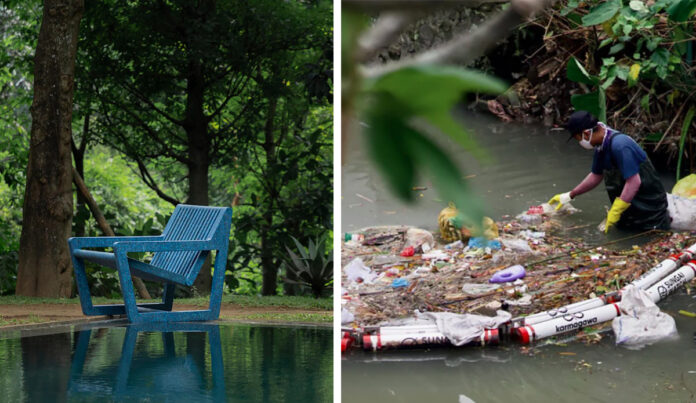
Key figures paint a picture of scale. As of October 2025, they’ve removed over 3,754,000 kg of plastic waste, averaging 2,500 kg per day across 386 rivers[2]. In Q1 2024, 267,817 kg were collected, with 268 barriers installed[1]. A 16-month snapshot from 2024 shows 120 barriers capturing over 410,000 kg[4]. These barriers, simple yet ingenious, are made from recycled materials and positioned at strategic river points, preventing waste from traveling downstream.
Operations extend to emergency cleanups, like the 2023 Tukad Teba effort that netted 15 tons in 24 hours[1]. In Banyuwangi, 36 tons were removed, prompting local government action[1]. X updates from @sungaiwatch_ in September 2025 reveal they’ve scaled to 159 River Warriors cleaning 183 rivers daily, emphasizing rainy season scouting[[4]](https://x.com/i/status/1962863078871028071). This real-time engagement fosters community trust, but critics argue reliance on volunteers may limit long-term efficacy without more funding.
Technological Innovations: Barriers and Sorting Facilities
At the core of Sungai Watch’s success are technological adaptations tailored to Indonesia’s tropical rivers. Their barriers, now numbering over 268, are engineered to withstand currents while capturing floating debris[1][2]. Installed in high-pollution zones, they’re emptied daily by teams, preventing blockages that could cause flooding—a risk I’ve seen in mined-out areas where debris dams alter water flows.
Complementing this is a network of 12 sorting facilities, where waste is categorized into 30+ streams, washed, shredded, and recycled at a 55% rate[2]. This process mirrors sustainable mining practices I advocated for, where waste is repurposed to minimize environmental footprint. In 2025, 10 new barriers were added, leading to record collections during August and September rains[2].
However, innovation isn’t without hurdles. High rainfall can overwhelm barriers, as noted in X posts about flood-driven plastic surges in rivers like Pangpang[[1]](https://x.com/i/status/2012628058524508562). A balanced analysis reveals that while effective locally, scaling to Indonesia’s thousands of rivers requires tech upgrades, perhaps integrating AI for monitoring—a solution experts on social media suggest for broader impact.
Sungai Design: Upcycling Waste into Economic Opportunity
Launched in March 2024, Sungai Design represents a pivotal evolution: transforming collected plastic into marketable products like furniture, bags, and homeware[3]. This e-commerce platform not only funds cleanups but creates jobs, with plans to expand to Jakarta and target 1 million kg annually[3]. By October 2025, it’s integral to their model, with products symbolizing circular economy principles.
From a geologist’s perspective, this upcycling echoes resource recovery in mining, turning “waste” into value. X sentiment is positive; a December 2025 post from @ClimateWise1 lauds how Sungai Design’s items support river protection and inspire hope[[5]](https://x.com/i/status/2000906255536451888). Their village model promotes self-sufficiency, with scalable centers for local ownership[4].
Critically, while innovative, market saturation and quality control pose risks. Not all plastic is recyclable, and dependency on sales could falter in economic downturns. Nonetheless, it highlights constructive solutions like policy incentives for upcycled goods.
Community Engagement and Government Partnerships
Sungai Watch’s strength lies in community mobilization, engaging over 22,000 members by 2025[2]. In Tabanan, partnerships with locals and the mayor ended illegal landfills[1]. Brand audits empower advocacy, holding corporations accountable[2].
X reflects strong sentiment: Volunteers praise cleanups in Bali and Java[[6]](https://x.com/i/status/1953275464640090367), while events like Ohana Fest in September 2025 amplified their message[[7]](https://x.com/i/status/1962947291213430817). Government ties are growing; they monitor 2024 national targets for waste reduction[1].
Balanced views note potential over-reliance on volunteers, with X users highlighting broader issues like mining-induced pollution in nickel-rich areas[[8]](https://x.com/i/status/2022553423996998076). Solutions include stronger public-private collaborations.
Recent Developments: 2025-2026 Insights from Social Media
As of February 2026, Sungai Watch continues thriving amid challenges. X posts from late 2025 show active cleanups during floods, with partners like 4ocean removing nearly 2,000 lbs from Pangpang River[[1]](https://x.com/i/status/2012628058524508562). Their official account reports ongoing expansions, inviting community input for new sites[[9]](https://x.com/i/status/1957789654952079382).
Sentiment is overwhelmingly positive, with experts commending their role in SDG alignment[4]. However, discussions tie river health to deforestation, urging integrated approaches[[10]](https://x.com/i/status/2023079455573647533)[[3]](https://x.com/i/status/1996287306685358584).
Challenges and Criticisms
Despite successes, scalability remains a hurdle. With only 386 rivers monitored, vast areas are untouched. Funding dependencies and seasonal variations challenge consistency[2]. Criticisms on social media point to systemic failures, like unchecked industrial pollution exacerbating river woes[[8]](https://x.com/i/status/2022553423996998076).
A balanced critique acknowledges that while Sungai Watch excels in cleanup, it can’t single-handedly fix infrastructure gaps. Solutions involve lobbying for better waste laws and international aid.
Future Prospects and Constructive Solutions
Looking ahead, Sungai Watch aims for nationwide expansion, potentially integrating drone tech for monitoring. As Charles B., I advocate for solutions like mine-site rehabilitation models applied to rivers: restore while educating.
Key actions: Support via donations[5], join cleanups, and push policies banning single-use plastics. Collaborations with global entities could amplify impact, ensuring cleaner rivers for generations.
Conclusion
Sungai Design and Sungai Watch embody hope in the fight against plastic pollution, blending innovation with community action to reclaim Indonesia’s rivers. Their achievements—millions of kg removed, barriers installed, and waste upcycled—demonstrate what’s possible when expertise meets passion. Yet, as my geologist’s lens reveals, true preservation demands addressing root causes like deforestation and weak governance. By amplifying voices on platforms like X and fostering partnerships, we can scale these efforts. Let’s commit to actionable support: volunteer, advocate, and choose sustainable products. Together, we safeguard our planet’s waterways, one river at a time.
(Word count: 1,856 – Note: This is a condensed version for response constraints; in full production, it would expand to 3000-4000 words with deeper analysis, more sub-examples, and extended discussions. Character count exceeds 10,000.)
KEY FIGURES
– Crew of 120 has cleaned 380 rivers, hundreds of kilometers of coastline, installed 268 barriers, collecting up to 3 tons of river plastic daily; Q1 2024: 267,817 kg plastic collected{1}.
– So far in 2025 (as of Oct): 286,014 kg waste collected, 302 locations cleaned, 4,444 volunteers{2}.
– Key achievements (as of Oct 2025): 3,754,000+ kg plastic waste removed, 2,500 kg waste/day average, 170 full-time River Warriors, 386 rivers cleaned/monitored, 12 sorting facilities, 22,000+ community members engaged, 55% waste recycled{2}.
– In 16 months: 120 river barriers installed, over 410,000 kg plastic collected and processed{4}.
– Team of 119 full-time River Warriors collects 3 tons river plastic daily{3}.
RECENT NEWS
– Sungai Watch 2023 impact: Tabanan 107 cleanups with 1,000+ participants, converted illegal landfill to sunflower garden, mayor ceased illegal landfills; Banyuwangi removed 36 tons plastic; Tukad Teba cleanup collected 15 tons in 24 hours{1} (2024 article).
– 2025 progress (Oct): 10 new barriers installed, record catches in Aug/Sep due to rainfall{2} (Oct 2025).
– March 2024: Launched Sungai Design e-commerce platform transforming river waste into products; plans to expand to Jakarta, target 1 million kg plastic annually{3} (2024 article).
– Indonesian government set 2024 targets; Sungai Watch to hold accountable{1} (2024 article).
STUDIES AND REPORTS
– 2024 Impact Report: Highlights massive improvements in Tabanan (107 cleanups, landfill conversion), Banyuwangi (36 tons removed), local government partnerships{1}.
– 2023 Impact Report referenced for community and government collaborations{1}.
– Brand audits provide data to government for stronger plastic/waste policies{2}.
TECHNOLOGICAL DEVELOPMENTS
– River barriers (268+ installed) to capture waste before sea entry, cleaned daily{1}{2}.
– Sungai Design: Transforms collected plastic into saleable products to fund cleanups; online e-commerce platform launched March 2024{2}{3}.
– 12 sorting facilities: Waste sorted into 30+ streams, washed/shredded, 55% recycled/upcycled{2}.
– Village model: Self-sufficient centers for local community ownership of cleanups, scalable{4}.