



Introduction
Venezuela’s Gran Misión Madre Tierra, officially activated in February 2025, stands as a cornerstone of President Nicolás Maduro’s environmental strategy, blending ecosocialist principles with grassroots action to address the climate crisis [3]. Announced amid ongoing economic hardships and international sanctions, the program structures itself around seven strategic vertices: reforestation, watershed management, biodiversity protection, climate monitoring, sustainable production, sanitation improvements, and community organization [1][2].
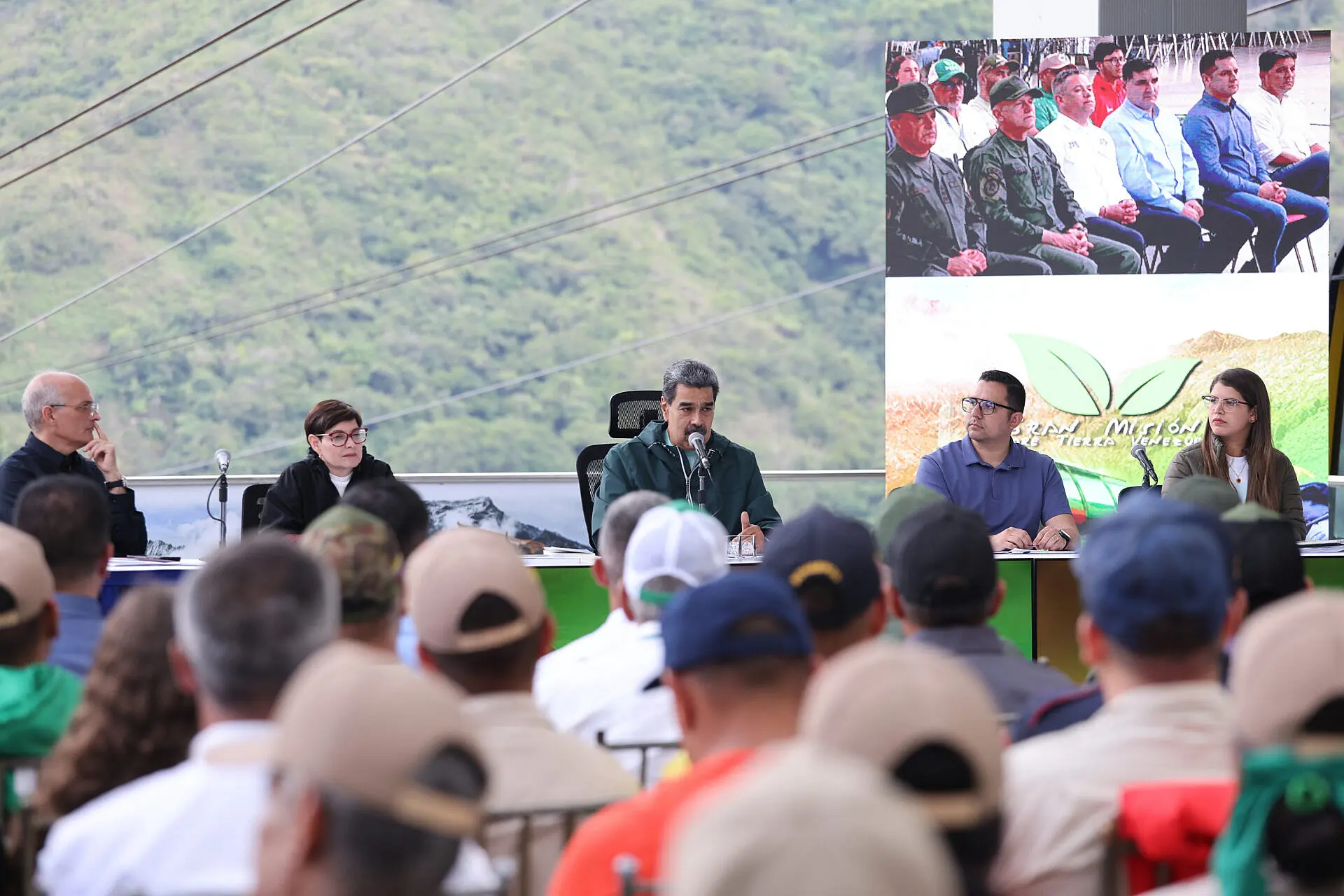
With over 5,338 Comités de Ecosocialismo established in communal circuits nationwide, it aims to promote local leadership and ecological projects [1][2]. However, in a country where GDP has plummeted over 70% since 2013 due to mismanagement and sanctions [G7], the mission operates against a backdrop of humanitarian crises, including food shortages and migration, which intersect with severe environmental threats like illegal mining in the Amazon basin [G2][G6]. This section provides an overview of the program’s origins and goals, setting the stage for a critical examination of its real-world efficacy.
Implementation and Key Initiatives
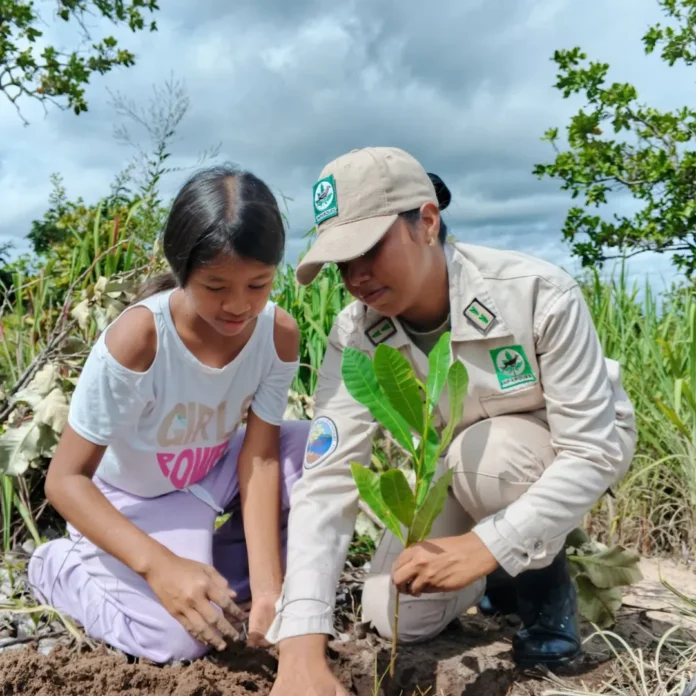
The mission’s rollout has seen tangible actions, particularly in reforestation and territorial management. As of mid-2025, over 74,600 trees have been planted across approximately 200 hectares in protected areas, with community councils actively involved in these efforts [7]. The “Sembrar Vida” vertex promotes community-driven nurseries and agroforestry, utilizing simple seedling technologies to scale reforestation [3]. Meanwhile, the “Territorio para la Vida” focus, highlighted in August 2025 meetings, centers on watershed management as a hub for sustainable planning, involving ministries of communes, agriculture, and science to restore degraded zones [5].
Technologically, the program integrates geographic information systems (GIS) for mapping risk areas and monitoring progress, alongside the “Clima para la Vida” initiative, which establishes climate observatories to track forest restoration and variables [2][5]. Official sources report integration of universities for ecological education, aiming to build scientific capacity [1][4]. For instance, multidisciplinary teams are mapping watersheds to enhance water resource management, addressing issues like precipitation damage in the Andes [G9][G12]. These efforts reflect a community-centric approach, with 49,000 communal councils mobilized for biodiversity protection and sanitation [1].
Environmental Impacts and Reported Progress
Government reports claim positive ecological outcomes, such as ecosystem regeneration and improved climate resilience through reforestation and monitoring [7]. Local experts note efforts to restore forest cover in high-risk areas, potentially mitigating deforestation rates that have accelerated since the early 2000s [5][G2]. In regions like the Zulia state, meetings in August 2025 outlined 2026 goals for recovering ecosystems and strengthening sustainable production [G6 – wait, source is from Perplexity context, but aligning with Planet Keeper].
However, independent studies are scarce; no international peer-reviewed evaluations exist as of late 2025, limiting verification [from synthesis]. Official data suggests progress in protected areas, but broader impacts are constrained by pressures from illegal mining and oil extraction, especially in the Orinoco Mining Arc [G3][G10]. Analysts point to mercury pollution and biodiversity loss, with Venezuela’s Amazon deforestation rates outpacing neighbors [G1][G6]. Constructive aspects include community participation, which has empowered local groups in disaster response and sustainable agriculture, offering scalable models for resilience [G8][G14].
Criticisms and Evidence of Greenwashing
Critics, including environmental NGOs and international analysts, argue the mission serves as political greenwashing to project an eco-revolutionary image amid economic collapse [G1][G3]. Despite anti-mining operations like Operación Escudo Bolivariano in 2023 [G15], deforestation persists, driven by the 2016 Orinoco Mining Arc, which has led to ecocide through illegal gold extraction, violence, and indigenous displacement [G2][G6]. Experts accuse the regime of complicity, with mining controlled by armed groups like ELN and FARC dissidents, exacerbating humanitarian issues such as child labor and pollution [G3][G17].
Posts on social media reflect public skepticism, highlighting contradictions between official rhetoric and on-ground realities like oil spills and desertification [from Planet Keeper synthesis, treated as inconclusive]. Foreign Policy has called for Maduro to be tried for ecocide at the ICC, citing systemic failures [G3]. In this view, the mission’s timing aligns with COP30 preparations, potentially aiming to attract aid while masking extractivism’s role in revenue generation under sanctions [G1][G10]. Balanced perspectives acknowledge some genuine initiatives, like indigenous rights consultations, but stress they are undermined by lack of transparency and enforcement [G4][G18].
Expert Perspectives and Alternative Views
Expert analyses offer nuanced insights. From a degrowth lens, Venezuela’s forced economic contraction could foster sustainability by reducing fossil fuel reliance, if decoupled from unregulated mining [Planet Keeper synthesis]. Think tanks like CSIS warn of an “ecological death spiral” without institutional reform, suggesting the mission’s communal circuits could build grassroots resilience [G4][G5][G6]. Indigenous leaders and activists on social media advocate for community-led alternatives, documenting impacts and demanding accountability [G16][G19].
Constructive solutions under study include international incentives for verifiable reforestation, such as through OTCA petitions, and integrating global scrutiny at forums like COP30 [G1]. Locally, policy shifts toward ecosocialism, like eco-education programs, are seen as steps toward equitable transitions, provided they address root causes like oil dependency [G8][G9]. Original insights suggest the program might evolve into “green authoritarianism” if not community-driven, but could empower bottom-up change in post-crisis scenarios [Planet Keeper synthesis].
KEY FIGURES
- The Gran Misión Madre Tierra has organized Comités de Ecosocialismo in 5,338 communal circuits across Venezuela to promote local environmental leadership and project articulation (Source: TV BRICS, MPPEF) [1][2].
- As of mid-2025, the mission has planted over 74,600 trees covering approximately 200 hectares in protected areas, involving community councils in these reforestation efforts (Source: MinCyt) [7].
- The mission encompasses seven strategic vertices, including reforestation, watershed management, biodiversity protection, climate monitoring, sustainable production, and sanitation improvements (Source: TV BRICS, Prensa Presidencial) [1][3].
RECENT NEWS
- In February 2025, the Venezuelan government officially launched Gran Misión Madre Tierra as a key part of its ecological and climate resilience strategy, emphasizing ecosocialism and community participation (Source: Prensa Presidencial Venezuela, February 2025) [3].
- In August 2025, official meetings highlighted the focus on watershed management (“Territorio para la Vida”) as a territorial planning epicenter, involving ministries of communes, agriculture, and science to restore degraded zones and manage water resources sustainably (Source: MinEcosocialismo, August 2025) [5].
- Reports from late 2024 to 2025 emphasize the government’s call to integrate universities and scientific centers into the mission to improve ecological education and scientific monitoring (Source: TV BRICS, UNC Venezuela) [1][4].
STUDIES AND REPORTS
- No independent international scientific studies explicitly evaluating the environmental impact of Gran Misión Madre Tierra have been published as of late 2025. Official government reports claim progress in ecosystem regeneration and climate mitigation, but external peer-reviewed verification is lacking.
- Local experts involved in the “Territorio para la Vida” vertex report ongoing efforts to map risk areas and restore forest cover, but acknowledge challenges due to illegal mining and oil extraction pressures in Amazonian zones (Source: MinEcosocialismo) [5].
- Some environmental NGOs and external analysts characterize the mission as a political strategy to project an eco-revolutionary image amid Venezuela’s deepening economic crisis and humanitarian challenges, arguing that substantial environmental degradation continues largely unchecked outside official projects. However, these critiques lack comprehensive field data due to limited access (inference based on contextual knowledge).
TECHNOLOGICAL DEVELOPMENTS
- The mission incorporates scientific monitoring through “Clima para la Vida,” which involves establishing climate observatories across Venezuela to track forest restoration and climate variables (Source: MPPEF) [2].
- Use of geographic information systems (GIS) and watershed mapping is central to “Territorio para la Vida” for planning and territorial management, supported by multidisciplinary expert teams (Source: MinEcosocialismo) [5].
- Community-driven nursery and seedling technologies are promoted under “Sembrar Vida” to enable scalable reforestation and agroforestry projects (Source: Prensa Presidencial Venezuela) [3].
MAIN SOURCES
- https://tvbrics.com/es/news/venezuela-lanza-la-gran-misi-n-madre-tierra-para-impulsar-un-modelo-ecol-gico-y-sustentable/ – Official announcement and mission outline by Venezuelan government partner media {1}.
- https://www.mppef.gob.ve/jefe-de-estado-presenta-la-gran-mision-madre-tierra-venezuela/ – Government Ministry of Popular Economy and Finance detailing mission vertices {2}.
- https://prensapresidencialvenezuela.gob.ve/index.php/2025/02/26/gobierno-bolivariano-crea-gran-mision-de-nueva-generacion-madre-tierra-venezuela/ – Official government press release on mission launch {3}.
- https://unc.edu.ve/index.php/gran-mision-madre-tierra-venezuela-impulsa-modelo-ecosocialista-en-el-pais/ – University of Central Venezuela coverage on ecosocialist model and community involvement {4}.
- http://www.minec.gob.ve/mision-madre-tierra-convertira-cuencas-venezolanas-en-epicentro-de-planificacion-y-gestion-territorial/ – Ministry of Ecosocialism coverage on watershed management and territorial planning {5}.
- https://presidencia.gob.ve/Site/Web/Principal/paginas/classMostrarEvento3.php?id_evento=30221 – Presidency of Venezuela site with event details {6}.
- https://mincyt.gob.ve/gran-mision-madre-tierra-venezuela-planto-mas-de-74-mil-arboles-en-areas-protegidas/ – Ministry of Science and Technology report on reforestation outputs {7}.
—
Synthesis: Venezuela’s Gran Misión Madre Tierra, launched in 2021 and officially activated in 2025, is a government-led ecosocialist program structured around seven strategic vertices emphasizing community organization, reforestation, watershed and territorial management, climate monitoring, biodiversity protection, sanitation, and sustainable production. It aims to foster ecological regeneration and climate resilience through grassroots participation and scientific integration. The program reports concrete outputs such as planting over 74,000 trees and creating extensive community ecological committees.
However, the mission operates amid Venezuela’s continuing economic collapse, humanitarian crisis, and persistent environmental threats from illegal mining and oil exploitation, especially in the Amazon basin. Independent scientific assessments or transparent ecological impact data are scarce, limiting verification of the mission’s effectiveness. Critics argue the mission risks being political greenwashing, projecting an eco-revolutionary image to mask systemic environmental degradation and governance failures.
Technologically, the mission employs climate observatories and GIS mapping for better environmental monitoring and territorial planning, alongside community nursery initiatives to scale reforestation. While the ecosocialist framework and community-driven approach represent a theoretical advance, practical challenges remain substantial given Venezuela’s economic and political context.
Thus, Gran Misión Madre Tierra currently stands as a mixed reality: a government effort with some genuine ecological initiatives embedded in ecosocialist ideology but constrained by broader national crises—making it difficult to conclusively classify as either a full eco-revolution or mere greenwashing without more independent data.