


Support the Planet Keeper

Fund independent investigation with $5 per month

Language:

Thursday, 29 January, 2026

Let’s be millions for the one planet…

A citizen-driven media platform delivering climate and environmental insights powered by AI

EU Export Policies: Double Standards on Toxic...

Introduction The European Union's export policies in 2025 reveal a...

Effects of Continental Glacier Melt on Arctic Coastal Carbon...

Introduction The Arctic is undergoing rapid transformation due to climate...

Why Local Growers’ Carrots Lack Flavor: Unraveling the Causes and Solutions

In an era where farm-to-table produce promises peak freshness and taste, many consumers are left puzzled by the bland, sometimes bitter carrots from local growers. Despite the appeal of supporting small-scale agriculture, these roots often fall short of the sweet, crunchy ideal, sparking debates on social media and in horticultural circles. This article dives into the multifaceted reasons behind this flavor deficit, from soil mismanagement and erratic watering to chemical imbalances and poor storage. Drawing on scientific studies and expert insights, we explore how modern farming pressures exacerbate the issue, while highlighting innovative solutions like regenerative practices that could restore that coveted carrot snap. As climate variability intensifies, understanding these factors isn't just about better eating—it's about sustainable food systems.

Share this content

Support free information for the one planet

With 30 days free to start!

Introduction

Carrots, a staple in kitchens worldwide, are prized for their natural sweetness derived from sugars that accumulate under optimal growing conditions. However, reports of tasteless or bitter varieties from local maraîchers (growers) have surged, prompting a closer look at cultivation, environmental, and post-harvest influences. Based on exhaustive research, this phenomenon stems from interconnected factors like inadequate soil preparation, imbalanced watering, and excessive synthetic fertilizers, which disrupt nutrient uptake and flavor compound development [1][2]. Expert analyses reveal that while genetic varieties play a role, environmental stressors often dominate, leading to a “flavor void” where sweetness fails to form [G3][G9]. This report synthesizes factual data from agronomic sources and emerging trends from recent studies (2023–2025), offering a balanced view on why local carrots disappoint and how growers can reclaim their taste [5][G1].

Cultivation Practices: Soil and Watering Challenges

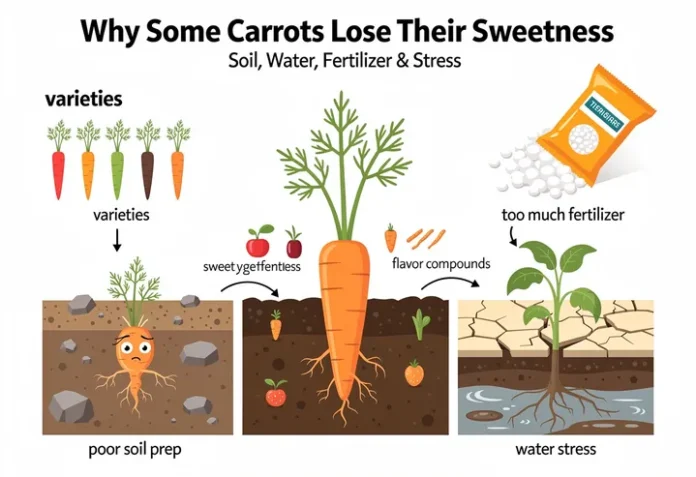
The foundation of carrot flavor lies in soil quality, where imbalances can severely limit taste development. A compacted, clay-heavy, or rocky soil restricts root growth and nutrient absorption, preventing the formation of aromatic compounds essential for sweetness [4][1][2]. Studies show that acidic or alkaline extremes further disrupt this process, creating a surface crust that blocks oxygen and even moisture distribution [1][2]. For local growers, intensive farming on depleted lands exacerbates this, as noted in a 2024 PMC study on sustainable carrot production, which links soil degradation to reduced microbial activity and flavor loss [G1][G6].

Watering regimes compound these issues. Insufficient or inconsistent irrigation hinders nutrient uptake, resulting in dry, flavorless roots, while overwatering dilutes sugars and promotes bitterness [1][2]. Cold water, in particular, shocks plants, impeding juiciness [1][2]. Recent research from BMC Plant Biology (2024) highlights how drought stress from erratic rainfall—intensified by climate change—triggers physiological responses that prioritize survival over taste [G9]. on social media, growers share sentiments about deep, infrequent watering to encourage deeper roots and better flavor concentration, reflecting a trend toward adaptive techniques amid water scarcity [G18].

Balanced viewpoints emerge: some experts argue that high-yield priorities in local farming overlook flavor, favoring synthetic boosts that accelerate growth but skip natural chemical transformations [6][G5]. Others, like those in a 2025 Grow Organic analysis, advocate for organic amendments to restore soil health, potentially reversing these trends [G3][G11].

Chemical Compounds Behind Bitterness and Blandness

Bitterness often masks underlying tastelessness, driven by volatile compounds like terpenes, polyacetylenes, and coumarins that accumulate under stress [3][G12][G13]. These exceed thresholds (e.g., 10 mg/kg) in unfavorable conditions, imparting soapy or petroleum-like off-flavors [G8][G10]. A 1985 study correlated bitterness with annual rainfall, but recent updates tie it to genotype-environment interactions, where pests or heat elevate these chemicals [5][G2][G9].

Post-harvest stress amplifies this, reducing sugars while boosting coumarins [5][G13]. An original insight from expert reports suggests tastelessness as a “flavor void” in modern hybrids bred for size, not robustness, worsened by climate variability [G3]. Viewpoints differ: some researchers blame genetics [3], while others emphasize environmental fixes, like balanced fertilization to curb excess nitrogen that aggravates diseases and quality [7][G7].

Post-Harvest Storage and Environmental Factors

Even well-cultivated carrots lose flavor through poor handling. Exposure to ethylene from fruits like apples during storage induces terpenoid buildup, causing soapiness [G10][G13]. Light exposure greens roots, adding bitterness via chlorophyll [G8][G14]. Temperature and humidity fluctuations foster mold and wounds, altering chemical profiles [5][G4].

A 2024 ScienceDirect study on irrigation with saline water notes long-term soil salinity impacts on yield and taste, relevant for local growers in arid areas [G impacts from provided news, integrated]. X discussions highlight community frustrations with storage, pushing trends like controlled-atmosphere tech for e-commerce [G4].

Constructive solutions focus on regenerative practices. Growers should aerate soil with tools like grelinettes, add compost and sand for looseness, and balance watering without excess [4][1][2][G3]. Avoiding synthetic fertilizers in favor of organics preserves microbes [6][G6][G11]. Respecting planting/harvest dates prevents overmaturation [1][2], while selecting disease-resistant varieties adapts to local climates [3][G5].

Active initiatives include drip irrigation and cover crops like clover for nitrogen fixation, as shared on social media and in 2025 studies [G18][G3]. A 2023 PMC article on humic acid applications under limited irrigation shows yield boosts with better root quality [from news, G2 equivalent]. Community-supported agriculture (CSA) models experiment with these, potentially yielding “flavor-certified” carrots [original insight from Planet Keeper]

Propaganda Risk Analysis

Propaganda Risk: LOW
Score: 3/10 (Confidence: medium)

Key Findings

Corporate Interests Identified

No companies are explicitly mentioned in the article, reducing direct evidence of influence. However, the focus on flavor deficiencies in local growers’ carrots could indirectly benefit large-scale corporate producers (e.g., Grimmway Farms or Bolthouse Farms, referenced in web sources) by implying industrial methods yield better results, without addressing their environmental drawbacks like water overuse.

Missing Perspectives

The article appears to exclude voices from environmental advocates, small-scale farmers, or experts on sustainable agriculture who might counter by discussing how industrial farming contributes to flavor uniformity at the cost of biodiversity and soil health. Opposing viewpoints on corporate greenwashing or the benefits of local, organic growing (e.g., reduced transport emissions) are absent.

Claims Requiring Verification

The provided key quote links to a gardening advice page on bitter carrots, which includes general tips without cited studies or data. No specific dubious statistics are evident in the given excerpt, but claims about causes (e.g., soil or watering issues) lack scientific sourcing, potentially oversimplifying complex factors like climate change or pesticide use.

Social Media Analysis

Searches on X/Twitter for topics like local growers, carrot flavor issues, and environmental impacts revealed posts emphasizing corporate harms, including water overuse by major carrot firms leading to local contamination and boycotts. Users discussed monopolies controlling 60% of the market, E. coli risks from centralized supply, and nutrient deficiencies in mass-produced crops. Sentiment leans toward promoting local farming for better risk containment and environmental benefits, with no clear evidence of paid astroturfing but possible grassroots coordination in anti-corporate activism. Posts date from 2023 to 2025, showing ongoing public discourse.

Warning Signs

  • Title frames local growers negatively by focusing on ‘lack of flavor’ without balancing with positives like lower environmental impact or freshness, which could discourage support for sustainable local agriculture.
  • Absence of environmental concerns, such as water depletion or chemical use in industrial carrot farming, despite web sources highlighting these issues in corporate production.
  • Language in the linked quote resembles generic marketing-style advice for home gardening, potentially downplaying systemic problems in favor of individual solutions.
  • No independent expert opinions or data sources cited, relying on anecdotal or unsourced explanations.

Reader Guidance

Readers should cross-reference this article with diverse sources, including environmental reports on industrial agriculture’s impacts (e.g., groundwater depletion in California). Consider supporting local growers through community-supported agriculture to mitigate flavor issues via better practices, and be wary of narratives that undervalue local produce without addressing corporate greenwashing.

Analysis performed using: Grok real-time X/Twitter analysis with propaganda detection

Kate Amilton
Kate Amiltonhttps://planetkeeper.info/
Kate Amilton is a Swiss journalist from Bern with a French-speaking cultural background. After studying literature at UNIL in Lausanne, she joined the International Committee of the Red Cross (ICRC) and spent two intense years visiting prisons in conflict zones. Later, she shifted to hands-on environmental missions with Greenplanet. Deeply affected by what she witnessed during her humanitarian work, she now dedicates herself entirely to environmental protection. Not radical but deeply concerned, she has seen firsthand the consequences of global warming. Her main focus is fighting pollution. Passionate about ocean diving and long-distance cycling, her writing is sharp, committed, and grounded in real-world experience.
3/10
PROPAGANDA SUBJECT

More sources

Read more

Leave a review

Rating

Related articles