


Introduction
The Ocean Cleanup, led by Boyan Slat, combines ocean-based systems and river interceptors to combat plastic pollution. Its core aim is to clean legacy waste while preventing new inflows, with a comprehensive strategy that includes policy advocacy [G8]. Recent data highlights tangible achievements, but debates on social media and in academic circles question its long-term efficacy amid concerns over greenwashing and insufficient focus on microplastics [G2, G7]. This section provides an overview of the project’s evolution, drawing from 2025 updates and studies.
Progress in Plastic Removal and Initiatives
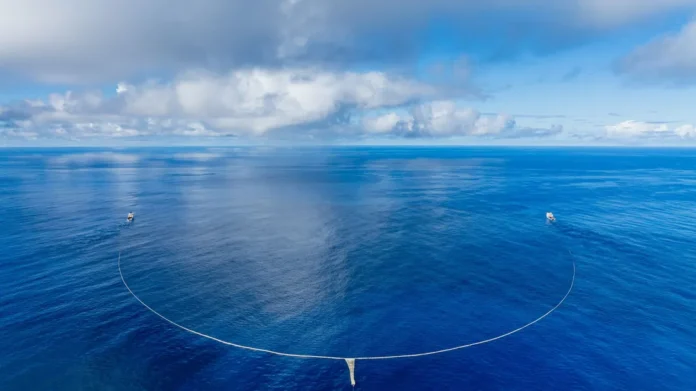
The Ocean Cleanup has made notable strides in 2025. As of June, operations have removed more than one million pounds (over 450,000 kg) of trash from the GPGP, equating to about 0.5% of the total accumulated waste [3]. Earlier, System 002 extracted over 84,000 kg by June 2022, building toward the 90% removal target by 2040 [2, G5]. The project’s 30 Cities Programme, launched to scale river interception, targets a 33% reduction in river plastic pollution by 2030, with Interceptors deployed in locations like Vietnam, Indonesia, and planned for Bangkok and LA County [5, 6, G9].
In oceans, a 2025 hiatus in extractions allows for a “hotspot hunting” initiative to map high-accumulation areas in the GPGP, enhancing future efficiency [3]. Additionally, the Pacific Data Expedition 2025 invites seafarers to study pollution, fostering data-driven cleanups [7]. A peer-reviewed study in Nature estimates that an 80% macroplastic cleanup in the North Pacific could reduce concentrations to safe levels for marine life, underscoring potential ecological benefits [9, G13].
Technological Developments and Challenges
System 03, the project’s most advanced ocean system, is set for 2025 deployment, promising greater efficiency in harvesting GPGP plastic [3, G6]. River Interceptors prevent inflows from 1,000 key rivers responsible for 80% of ocean pollution [G1]. However, challenges persist: annual plastic influx exceeds 8 million tons, dwarfing removal rates [G10]. Critics note that cleanups focus on macroplastics, leaving microplastics—trillions of particles—affecting food chains [G3, G4].
Funding estimates peg GPGP cleanup at $7.5 billion over 10 years or $4 billion over five, feasible against $13 billion in annual ecosystem damage [3, G2]. Yet, fuel-intensive operations raise climate concerns, per 2025 analyses [G12].
Criticisms and Expert Perspectives
Skeptics argue The Ocean Cleanup borders on greenwashing, funded partly by polluters, diverting from production reduction [G9, G10]. X discussions highlight this, with users debating tech fixes versus degrowth—reducing consumption to curb output projected to triple by 2060 [G7, G15-G20]. A Plymouth Marine Laboratory study weighs benefits against systemic alternatives, suggesting cleanups are like “mopping while the tap runs” without policy curbs [G12].
Expert views vary: some praise removal of 47+ tons in 2025 global efforts [1, G11], while others, in Microplastics journals, advocate integrating with bans that cut plastic bags by 25-47% [4, G14]. Ocean Conservancy data confirms policy efficacy, emphasizing neither cleanup nor interception alone suffices [G4]. From a degrowth lens, original insights suggest a hybrid model: cap production by 50% alongside tech for legacy waste, potentially achieving goals by 2035 at lower cost [G7].
Balanced Viewpoints and Constructive Solutions
Proponents view the project as a vital stopgap, providing data for treaties and preventing macroplastic degradation into microplastics [2, G5]. Critics push for accountability, noting corporate ties may enable business-as-usual [G9]. Balanced analyses, like UNEP reports, stress combining tech with prevention [G2].
Active solutions include expanding Interceptors and the 30 Cities Programme [5, 6, G9], alongside community-led cleanups in 25 countries [1, G11]. Emerging trends favor policy-tech hybrids, such as plastic treaties and biodegradable alternatives [G8, G10]. Studies advocate low-tech, inclusive approaches in affected regions to avoid community displacement [G3].
KEY FIGURES
– The Ocean Cleanup aims to remove 90% of floating ocean plastic by 2040, targeting both legacy waste and river inflow {2}{8}.
– As of June 2022, The Ocean Cleanup’s System 002 had removed over 84,000 kilograms of plastic from the Great Pacific Garbage Patch (GPGP) {2}.
– The Ocean Cleanup’s operations have removed more than one million pounds (over 450,000 kg) of trash from the GPGP since 2022, representing about 0.5% of the total accumulated trash {3}.
– The Ocean Cleanup’s 30 Cities Programme targets a 33% reduction in river plastic pollution by 2030, advancing toward the 90% ocean pollution reduction goal by 2040 {5}{6}.
– The cost to clean the Great Pacific Garbage Patch is estimated at $7.5 billion for a 10-year timeline, or $4 billion for a 5-year timeline {3}.
– A 2025 study estimates that an 80% cleanup of macroplastics in the North Pacific could reduce concentrations to within safe levels for marine mammals and sea turtles {9}.
RECENT NEWS
– In 2025, The Ocean Cleanup’s extraction operations are on hiatus for one year to deploy a new “hotspot hunting” initiative to map areas of intense plastic accumulation in the GPGP, aiming to make future extractions more impactful {3}.
– The Ocean Cleanup’s System 03, the largest and most efficient system yet, is in preparation for deployment in 2025 {3}.
– The Ocean Cleanup is launching the Pacific Data Expedition 2025, inviting sailors and seafarers to study plastic pollution in the GPGP {7}.
– The Ocean Cleanup’s 30 Cities Programme is scaling up river interception efforts in urban areas with multiple polluted waterways, aiming for a 33% reduction in river plastic pollution by 2030 {5}{6}.
STUDIES AND REPORTS
– A 2025 peer-reviewed study published in Nature estimates that an 80% cleanup of macroplastics in the North Pacific could reduce concentrations to within safe levels for marine mammals and sea turtles, suggesting that large-scale cleanup could have significant ecological benefits {9}.
– A 2025 peer-reviewed study in Science, analyzing Ocean Conservancy’s International Coastal Cleanup data, confirms that plastic bag bans lead to a 25%–47% reduction in plastic bags in the environment, highlighting the effectiveness of policy measures in reducing plastic pollution {4}.
– The Ocean Cleanup’s own data and modeling indicate that neither ocean cleanup nor river interception alone is sufficient to reduce ocean plastic; both are necessary for meaningful impact {2}.
– Ocean Conservancy’s analysis of its 40-year cleanup data shows that bans on single-use plastic bags are effective in reducing plastic pollution, supporting the need for policy-driven solutions alongside cleanup efforts {4}.
TECHNOLOGICAL DEVELOPMENTS
– The Ocean Cleanup’s System 03, the largest and most efficient system yet, is in preparation for deployment in 2025, designed to harvest plastic from the GPGP more effectively {3}.
– The Ocean Cleanup’s Interceptor systems are deployed in rivers in Vietnam, Indonesia, Jamaica, Dominican Republic, Malaysia, and planned for Bangkok, Thailand, and LA County, USA, to intercept plastic before it reaches the ocean {2}{6}.
– The Ocean Cleanup’s 30 Cities Programme is scaling up river interception efforts in urban areas with multiple polluted waterways, aiming for a 33% reduction in river plastic pollution by 2030 {5}{6}.
– The Ocean Cleanup’s “hotspot hunting” initiative in 2025 will use advanced mapping to identify and target areas of intense plastic accumulation in the GPGP, improving the efficiency of future extractions {3}.
MAIN SOURCES
- UN partnership page detailing The Ocean Cleanup’s goal to remove 90% of floating ocean plastic by 2040 and describing their river and ocean strategies {2}.
- Press release from The Ocean Cleanup detailing the cost, timeline, and progress of their GPGP cleanup efforts, including the deployment of System 03 and the 2025 hiatus for hotspot hunting {3}.
- The Ocean Cleanup’s update on their comprehensive approach, including river interception, ocean cleanup, and policy advocacy {6}.
- Ocean Conservancy’s statement on a peer-reviewed study confirming the effectiveness of plastic bag bans in reducing plastic pollution {4}.
- Article on The Ocean Cleanup’s 30 Cities Programme and its goals for reducing river plastic pollution {5}.
- The Ocean Cleanup’s official updates page, detailing their latest projects and technological developments {8}.
- Announcement of The Ocean Cleanup’s Pacific Data Expedition 2025, inviting participation in studying plastic pollution in the GPGP {7}.
- Peer-reviewed study in Nature estimating the ecological impact of large-scale ocean plastic cleanup in the North Pacific {9}.


