


Introduction
Ghana’s mangroves, concentrated in the Western Coast and Volta regions, are vital ecosystems facing rapid decline. Between 2009 and 2019, the country lost about 16.9% of its mangrove cover and 21% of other vegetation due to human pressures like agriculture, urbanization, and pollution [2]. Restoration efforts, such as the Anlo Wetlands ReDAW project, aim to reverse this by restoring 2,620 hectares initially, with potential expansion to the full 9,980-hectare Keta Lagoon area [1]. These initiatives promise significant carbon sequestration—nearly 2 million tonnes of CO2 over 40 years—while enhancing biodiversity and livelihoods [1]. However, expert analyses reveal concerns over ecological justice, including corporate exploitation via carbon credits and displacement of local communities [G13]. This section overviews the factual landscape, setting the stage for a critical examination of successes, challenges, and pathways forward.


The State of Mangrove Decline and Restoration Efforts
Recent studies underscore the precarious state of Ghana’s mangroves. A 2023 nonparametric assessment using Google Earth Engine and Random Forest algorithms revealed significant losses, with aboveground biomass impacted by anthropogenic factors [2]. The InVEST model in this study demonstrated mangroves’ role in reducing coastal hazard indices, emphasizing their value as nature-based defenses [2]. Complementing this, a 2024 spatiotemporal analysis positions protection and restoration as key climate solutions, highlighting declines in the Volta Delta [5].
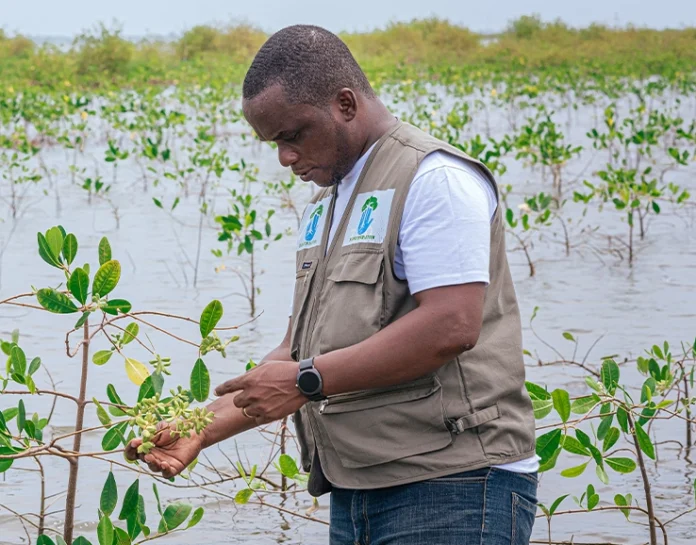
On the restoration front, projects like ReDAW, launched in early 2024 by Seawater Solutions and Terraformation, involve local communities in planting native mangroves, winning the Great Blue Wall Challenge [1]. This initiative, expanding from a successful pilot, now spans six countries and trains local foresters via Terraformation’s Seed to Carbon Forest Accelerator [1]. Similarly, the UNFCCC-backed IMPACT-Ghana program targets integrated restoration along eastern and western coastlines, focusing on cost-effective strategies [3]. The WACA Program’s report details afforestation benefits in these regions, including enhanced coastal resilience and livelihoods for women [6]. A desk research piece on SSRN examines lessons from these efforts, noting improved ecosystem services but persistent threats from pollution [4].
Yet, global parallels warn of pitfalls. A 2022 MDPI review documents an 8,600 km² worldwide mangrove decline from 1990-2020, driven by similar factors in Africa [G2]. In Ghana, illegal mining (galamsey) exacerbates degradation, polluting water bodies and threatening habitats, as highlighted in online discussions [G15].
Ecological Justice Concerns: Exploitation and Displacement
Critics argue that restoration often masks corporate agendas. Through a degrowth lens, projects commodify nature via carbon credits, benefiting distant corporations while locals face displacement [G13]. In the Volta Delta, fisherfolk report evictions from protected zones, echoing Southeast Asian patterns where restoration displaces indigenous groups [G11]. A 2025 Environmental Justice Foundation film exposes how industrial pollution from oil and mining undermines gains, prioritizing offsets over subsistence [G14].
social media sentiments amplify these views, with users decrying political inaction on galamsey and potential “water bodies restoration taxes” amid environmental neglect [G15]. Experts note greenwashing risks, where eco-tourism and credits overshadow pollution accountability [G9]. A ScienceDirect framework from Nigeria highlights similar corporate dominance in African contexts [G1]. In Ghana, this manifests as socio-economic inequalities, with indigenous communities bearing degradation costs without equitable benefits [G6].
Balanced perspectives emerge: Some web analyses praise community participation for boosting success, as in Sri Lanka’s models where local involvement increased coverage [G3]. Ghana’s 2025 Global Voices piece stresses mangroves’ socio-economic potential but calls for transparent funding to avoid failures [G13].
Community Involvement and Carbon Sequestration Challenges
Community-led models offer hope. In Anlo Wetlands, partnerships empower residents in planting and monitoring, fostering ownership and biodiversity [1]. The ReDAW project integrates indigenous knowledge, aligning with UNFCCC submissions for strategic restoration [3]. Globally, mangroves sequester up to 1,000 tonnes of CO2 per hectare, making Ghana’s efforts crucial for climate goals [G4].
Challenges persist: A 2024 Springer study emphasizes participation’s role but notes policy gaps in countering socio-economic pressures [G5]. In Ghana, urban expansion and disasters hinder sequestration potential, as per Ashanti region analogs [G8]. X posts highlight mangroves’ blue carbon prowess—storing 3-5 times more per hectare than rainforests—yet warn of losses without protection [G16].
Solutions under study include hybrid approaches blending tech like SRTM for biomass estimation with grassroots cooperatives [2]. Degrowth advocates propose low-impact stewardship, decoupling from export economies to prioritize equity [G7].
Constructive Perspectives and Future Solutions
Optimistic views focus on participatory successes. COP30 pledges for land tenure recognition could benefit Ghana’s indigenous groups, committing 160 million hectares globally [G4]. Community-based management in Mozambique offers lessons for Ghana, showing adequacy in sustaining livelihoods [G10].
Concrete solutions include ethical carbon projects with transparent funding, as proposed in online resistance [G17]. Empowering fisherfolk cooperatives for monitoring could prevent failures, integrating indigenous knowledge with tools like InVEST [2]. A 2025 Nature4Climate analysis urges high-integrity offsets, while degrowth models advocate subsistence over monetization [G4].
Emerging trends favor grassroots resistance against exploitation, with 2025-2026 discussions pushing for policy reforms [G18]. Films and reports like EJF’s amplify voices, fostering accountability [G14].
KEY FIGURES
– Ghana’s Anlo Wetlands ReDAW project on track to restore 2,620 hectares of native mangroves, with potential for full 9,980-hectare Keta Lagoon area{1}.
– Expected sequestration of nearly 2 million tonnes of CO2 over 40-year timeframe in Anlo Wetlands project{1}.
– About 16.9% of mangrove cover and 21% of other vegetation lost between 2009 and 2019{2}.
– Mangroves primarily located in Ghana’s Western Coast and Volta regions{6}.
RECENT NEWS
– Local communities in Anlo Wetlands partner with Seawater Solutions and Terraformation for mangrove restoration planting starting early 2024, winner of Great Blue Wall Challenge (2024, Source: terraformation.com/blog/rising-tides-rising-hopes-a-local-community-restores-mangroves-in-ghanas-anlo-wetlands){1}.
– Seawater Solutions completes successful mangrove pilot in Ghana, expanding to 6 countries (2024, Source: terraformation.com/blog/rising-tides-rising-hopes-a-local-community-restores-mangroves-in-ghanas-anlo-wetlands){1}.
STUDIES AND REPORTS
– Nonparametric assessment of mangrove ecosystem (2023): 16.9% mangrove and 21% vegetation loss 2009-2019; human pressures impact extent and aboveground biomass; mangroves reduce coastal hazard index via InVEST model; calls for mapping to assess conservation role (Source: pmc.ncbi.nlm.nih.gov/articles/PMC10388404/){2}.
– Restoring Mangrove Ecosystems for Coastal Resilience (SSRN, recent desk research): Examines status, threats, restoration efforts in Ghana, focusing on lessons learned (Source: ssrn.com/abstract=4787013){4}.
– Spatiotemporal Changes in Ghana’s Mangrove Ecosystems (2024): Protection and restoration as nature-based solutions to climate change (Source: onlinelibrary.wiley.com/doi/10.1002/aqc.70187){5}.
– IMPACT-Ghana: Integrated Mangrove restoration (UNFCCC submission 2025): Strategic, cost-effective restoration along eastern/western coastlines (Source: unfccc.int/sites/default/files/resource/Ghana-20251002_CN_IMPACT-SJWA-submission.pdf){3}.
– Benefits of Mangrove Afforestation and Restoration (WACA Program): Studies from Western Coast and Volta regions highlight benefits (Source: wacaprogram.org/sites/default/files/knowdoc/Ghana%20and%20Guinea%20-%20Mangroves%20-%20Afforestation%20Restoration%20Woman.pdf){6}.
TECHNOLOGICAL DEVELOPMENTS
– Google Earth Engine (GEE) for mangrove mapping and temporal/spatial variation assessment{2}.
– Random Forest (RF) algorithm with 100 trees for landcover classification training{2}.
– SRTM digital elevation for mangrove canopy height estimation linked to aboveground biomass{2}.
– InVEST model for shoreline hazard index calculation with/without mangroves{2}.
– Terraformation’s Seed to Carbon Forest Accelerator training local foresters{1}.
MAIN SOURCES (numbered list)
1. https://terraformation.com/blog/rising-tides-rising-hopes-a-local-community-restores-mangroves-in-ghanas-anlo-wetlands – Anlo Wetlands ReDAW project details, restoration scale, community benefits, CO2 sequestration.
2. https://pmc.ncbi.nlm.nih.gov/articles/PMC10388404/ – Scientific study on mangrove loss, biomass, coastal resilience using GEE, RF, InVEST.
3. https://unfccc.int/sites/default/files/resource/Ghana-20251002_CN_IMPACT-SJWA-submission.pdf – UNFCCC submission on integrated mangrove restoration along Ghana coasts.
4. https://www.ssrn.com/abstract=4787013 – Desk research on mangrove status, threats, restoration lessons in Ghana.
5. https://onlinelibrary.wiley.com/doi/10.1002/aqc.70187 – Study on spatiotemporal mangrove changes and nature-based solutions.
6. https://www.wacaprogram.org/sites/default/files/knowdoc/Ghana%20and%20Guinea%20-%20Mangroves%20-%20Afforestation%20Restoration%20Woman.pdf – Report on afforestation benefits in Western/Volta regions.


