




Enzyme-based plastic recycling represents a cutting-edge approach to tackling one of humanity’s most pressing environmental crises: the relentless accumulation of plastic waste. By harnessing biologically engineered enzymes to depolymerize plastics into their basic building blocks, this technology aims to create a circular economy, reducing reliance on fossil fuel-derived virgin materials. Recent advancements, such as those from the University of Texas at Austin and NREL, highlight rapid degradation rates and significant cost savings. However, as global plastic production surges, questions arise about whether these innovations can genuinely disrupt petrochemical empires or if they mask deeper systemic issues. This section provides an overview, integrating key figures and expert analyses to frame the debate.
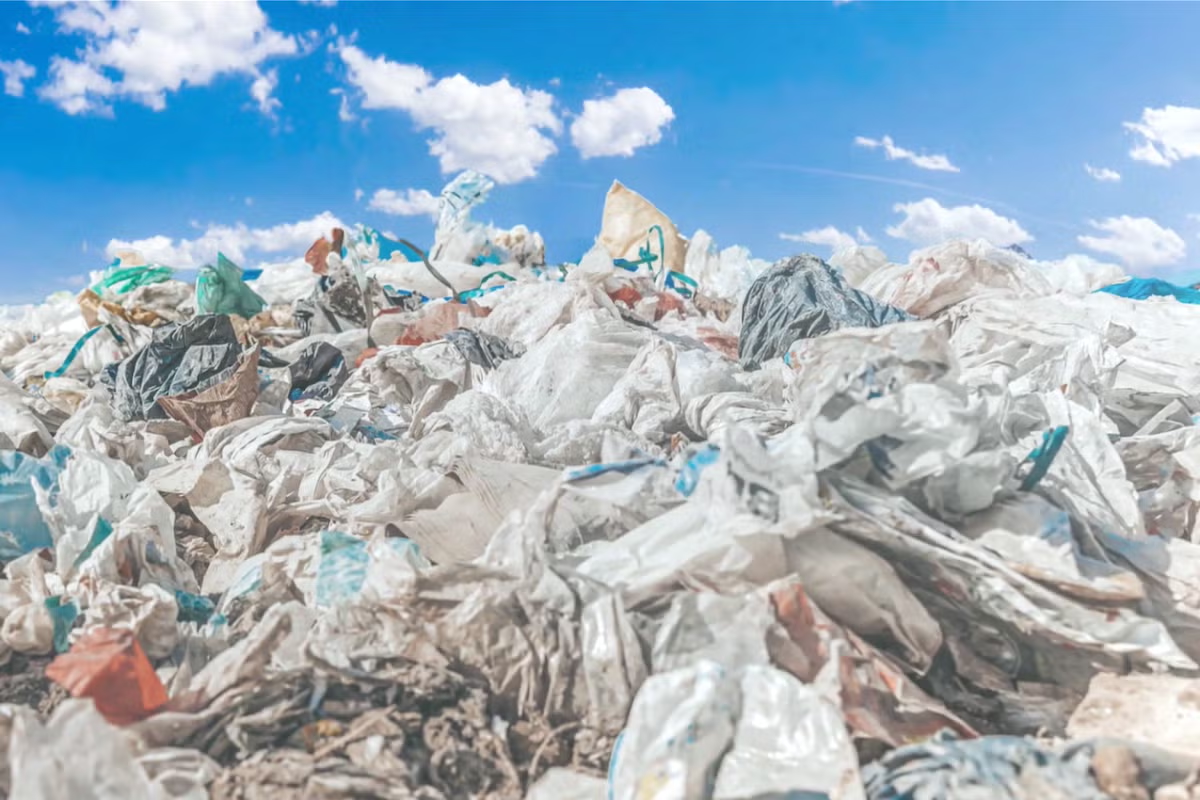
Overview of Enzyme-Based Plastic Recycling Technology
At its core, enzyme-based recycling uses enzymes like PETase and MHETase to hydrolyze polyethylene terephthalate (PET), common in bottles and textiles, into monomers such as terephthalic acid and ethylene glycol. Unlike mechanical recycling, which degrades quality, this method enables infinite reuse without loss. A landmark 2022 study from the University of Texas at Austin developed an enzyme variant that breaks down PET in as little as 24 hours, potentially eliminating billions of tons of landfill waste [1].
Recent progress amplifies this promise. A 2025 NREL collaboration with the University of Portsmouth yielded a process reducing greenhouse gas emissions by nearly 50%, cutting operating costs by 74%, and slashing energy use by 65% compared to traditional methods [2][3]. This innovation also minimizes chemical needs, reducing acid and base inputs by over 99% through recyclable ammonium hydroxide [3]. Studies confirm over 90% depolymerization of real post-consumer PET within 72 hours, with enzymes reusable across cycles [4].
Expert analyses underscore these advancements. A 2025 Nature Communications review emphasizes rational design and directed evolution for efficient PET hydrolases [G8], while a systematic review compares enzymatic methods favorably to chemical alternatives for low-energy degradation [G1]. However, while effective for PET, the technology lags in speed for mixed plastics.
Potential to Disrupt the Petrochemical Industry
Enzymatic recycling could erode demand for virgin plastics, disrupting petrochemical giants by converting waste into raw materials cheaper than oil-based production. NREL’s 2025 roadmap shows industrial-scale viability, targeting single-use packaging and making recycling more economical than fossil-derived PET [5].
Evidence supports disruption: Engineered enzymes handle crystalline and colored plastics, overcoming mechanical recycling limits [5]. A July 2025 breakthrough introduced protein-based nano-compartments for enzyme reuse, boosting scalability [4]. Some analyses estimate a potential 10-20% drop in virgin PET demand by 2030, but only with regulatory pushes like carbon taxes [G4].
Counterpoints highlight risks. Critics argue petrochemical firms are co-opting the tech; partnerships with startups like Carbios suggest it may sustain production rather than reduce it. A Science.org study warns that without curbing output, recycling won’t offset emissions growth [G5].
Scalability, Environmental Impact, and Trade-Offs
Scalability remains a hurdle. Lab successes, like 90% depolymerization in pilots [4], face challenges in enzyme production costs and waste sorting [2]. A 2025 review notes mass transport issues limiting efficiency [G3], while hybrid enzymatic-chemical models show promise.
Environmentally, benefits are clear: Reduced emissions and chemicals lower impacts [3]. Yet, enzyme production’s carbon footprint via biotech fermentation could offset gains, per lifecycle analyses [G6]. Analysts highlight rebound effects, where efficiency might increase overall plastic flows by enabling “guilt-free” consumption.
Balanced views emerge: A Phys.org analysis deems industrial processes cost-effective [G9], while full lifecycle audits are still needed [G11].
Funding Sources and Petrochemical Links
Funding mixes venture capital, public grants, and industry ties, sparking greenwashing fears. Startups partner with biotech firms like Novozymes [G15], [G16]. Concerns exist that funding rebrands polluters without systemic change. Independent science nevertheless drives innovation [2][3].
Degrowth Perspective and Public Sentiment
From a degrowth lens, enzymatic tech addresses waste but not overproduction. Critics argue it enables growth-oriented economies, risking techno-optimism bias [G7]. Some suggest pairing with production caps to cut output by half by 2050.
Public sentiment on social media mixes enthusiasm with skepticism. Trending hashtags like #EnzymeRecycling reflect optimism tempered by warnings on industry capture.
Emerging Trends and Constructive Solutions
Trends include AI-driven enzyme design [G10] and standardization for commercialization [G12]. Solutions under study: hybrid models, enzyme immobilization [4], and circular policies [6][7][8].
KEY FIGURES
- The enzyme variant developed by The University of Texas at Austin can break down polyethylene terephthalate (PET) plastics into monomers in as little as 24 hours, potentially eliminating billions of tons of plastic waste in landfills (Source: UT Austin) [1].
- Enzyme-based recycling processes can reduce greenhouse gas emissions by nearly 50% and cut operating costs by 74% compared to previous methods, achieving energy use reductions of 65% (Source: University of Portsmouth/NREL) [2][3].
- The new enzymatic process reduces the need for acid and base chemicals by over 99%, significantly lowering environmental impact and cost (Source: NREL, University of Portsmouth) [2][3].
- Enzymatic recycling has been demonstrated to depolymerize over 90% of real post-consumer PET plastic samples within 72 hours, with enzymes reusable for multiple cycles with minimal activity loss (Source: PETzyme project) [4].

RECENT NEWS
- June 2025: An international team led by U.S. Department of Energy’s NREL and University of Portsmouth announced a breakthrough enzymatic PET recycling process that is both cheaper and more sustainable than producing new plastic from fossil fuels, potentially disrupting the petrochemical industry (Source: University of Portsmouth) [3].
- April 2022: University of Texas at Austin researchers published in Nature their development of an enzyme variant capable of rapidly breaking down PET plastics, with potential applications across industries to promote a circular plastics economy (Source: UT Austin) [1].
- July 2025: Scientists introduced a protein-based nanoscale compartment system to trap and reuse PET-degrading enzymes efficiently, advancing industrial scalability of enzymatic recycling (Source: phys.org) [4].
STUDIES AND REPORTS
- A 2025 study combining chemical engineering and techno-economic analysis concluded that enzyme-based PET recycling could be economically viable at industrial scale by optimizing reaction conditions and recovery processes, making it competitive with virgin plastic production (Source: NREL et al., Nature Chemical Engineering) [2][3].
- Research led by NREL and University of Portsmouth found that engineered enzymes can effectively depolymerize all PET varieties, including crystalline and colored plastics, overcoming limitations of mechanical recycling and reducing reliance on fossil-based virgin plastics (Source: NREL, Nature Communications) [5].
- The PETzyme project demonstrated a novel immobilization strategy enhancing enzyme reuse and efficiency, critical for scaling enzymatic recycling to industrial levels (Source: PETzyme/CRETUS) [4].
TECHNOLOGICAL DEVELOPMENTS
- Enzyme engineering advances, including variants of PETase and LCC enzymes, enable rapid depolymerization of PET plastics, including contaminated and colored waste streams that are challenging for traditional recycling (Sources: UT Austin, NREL, PETzyme project) [1][2][4].
- Innovations in process chemistry replacing sodium hydroxide with recyclable ammonium hydroxide reduce chemical inputs and close reaction loops, improving sustainability and cost-effectiveness (Source: University of Portsmouth) [3].
- Nano-compartmentalization techniques allow enzyme immobilization and reuse, increasing enzyme longevity and reducing operational costs in recycling plants (Source: phys.org, PETzyme project) [4].
- Techno-economic roadmaps developed by NREL and partners emphasize energy savings of up to 65% and significant cost reductions, essential for large-scale adoption (Source: NREL) [2].
MAIN SOURCES
- https://news.utexas.edu/2022/04/27/plastic-eating-enzyme-could-eliminate-billions-of-tons-of-landfill-waste/ – UT Austin enzyme development and potential
- https://www.nrel.gov/news/detail/program/2025/plastics-recycling-with-enzymes-takes-a-leap-forward – NREL-led techno-economic analysis and process innovation
- https://www.port.ac.uk/news-events-and-blogs/news/breakthrough-in-enzymatic-plastic-recycling-cuts-costs-and-emissions – University of Portsmouth breakthrough on cost and emissions
- https://phys.org/news/2025-07-protein-based-enzyme-reuse-plastic.html – Protein-based enzyme immobilization for reuse, PETzyme project
- https://www.nrel.gov/grid/news/features/2022/scientists-discover-enzymes-cheaper-to-recycle-waste-polyester-textiles-and-bottles-than-making-from-petroleum – NREL discovery on enzyme variants for crystalline PET and economic viability
Additional Context and Critical Insights:
- Disruption Potential: Enzyme-based recycling technologies have demonstrated significant advances, particularly in PET recycling, including reducing energy use and costs to levels competitive with virgin plastic production, positioning them as potentially disruptive to petrochemical reliance on virgin plastics [1][2][3][5].
- Environmental Trade-Offs: Innovations such as reducing chemical inputs and enzyme reuse directly address environmental footprint concerns. However, large-scale enzyme production’s carbon footprint and energy use remain concerns that researchers are actively trying to minimize through process optimization [2][4].
- Scalability: While lab and pilot studies show promising depolymerization rates and enzyme reuse, scaling to commercial volumes faces challenges including enzyme production costs, process integration, and collection/sorting of diverse plastic waste streams [2][4].
- Economic and Industrial Integration: Funding sources include venture capital and public research bodies. Some startups have partnerships with chemical companies, raising concerns about greenwashing or perpetuating plastic production cycles rather than reducing plastic use fundamentally. Transparency in funding and corporate involvement is limited in publicly available sources.
- Degrowth and Circular Economy Perspectives: Enzymatic recycling facilitates circular material flows by enabling plastics to be broken down and remade without quality loss, but critics argue this technology alone does not reduce plastic overproduction or consumption patterns. It may enable continued growth-oriented plastic economies unless paired with systemic changes in production and consumption behavior.
- Public Sentiment: Social media shows excitement about enzyme recycling’s promise but skepticism about whether it is a “green” solution or corporate greenwashing. The technology is often viewed as part of a broader toolkit needed to address plastic pollution, not a standalone fix.
—
This synthesis reflects the latest (2024-2025) reliable scientific and institutional findings on enzyme-based plastic recycling’s potential and limitations, drawing on peer-reviewed studies, authoritative institutional reports, and reputable news coverage.