


Introduction
SilviProtocol, launched around 2023, positions itself as a tree stewardship platform leveraging blockchain to fund, track, and verify reforestation efforts globally [G1]. By tokenizing individual trees and carbon offsets as NFTs, it aims to create transparent links between donors, planters, and environmental outcomes, addressing longstanding issues in carbon markets like fraud and double-counting [1][4]. Recent developments, including its feature in 2024’s ReFi Week, highlight its role in regenerative finance, where Web3 tools democratize climate action [5]. However, critical voices from environmental NGOs warn of risks such as speculative commodification and monoculture plantations that could harm biodiversity in the Global South [G2][G5]. This section provides an overview of the platform’s evolution, integrating factual data with expert perspectives to evaluate its promise amid ongoing debates.
Technological Innovations and Transparency Mechanisms
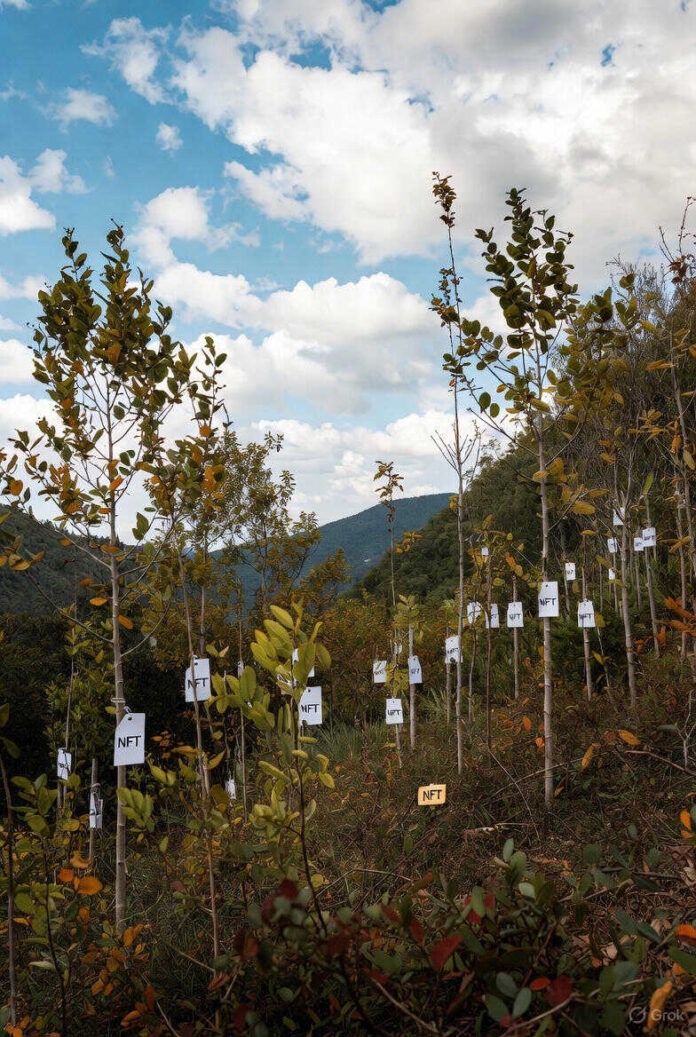
At its core, SilviProtocol employs NFT tokenization to represent planted trees, ensuring traceability through geo-tagging and on-chain data [1][2]. By 2024, it partnered with blockchain platforms like Cardano and Near to verify over 1 million trees, tokenized as carbon offsets [1][4]. This system prevents double-counting by linking physical planting to immutable blockchain records, a step praised in studies for enhancing accountability in forestation projects [4][G7]. Emerging integrations include acoustic sensors and satellite imagery for real-time monitoring of tree survival and forest health, currently in pilot stages to combat greenwashing [1][3].
Expert analyses underscore these advancements. A 2022 MDPI review highlights blockchain’s potential in sustainable forestry by providing secure tracking [G11], while 2025 discussions on social media reflect enthusiasm for SilviProtocol’s bioregional grants, which fund localized projects with matched donations [G20]. However, challenges persist: actual environmental benefits hinge on tree survival rates, often under 50% in poorly managed initiatives, and local ecosystem compatibility remains under-monitored [1][2][G10].
Environmental Impact and Criticisms
While SilviProtocol touts impressive figures—like training over 500 students and farmers in sustainable practices via 10 workshops by 2025 [6]—critical studies reveal gaps. A 2024 analysis notes that blockchain enhances transparency but doesn’t guarantee ecological integrity, with risks of prioritizing speculative carbon sales over biodiversity [2][G2]. In the Global South, expansions of tree plantations for offsets have doubled since 2021, sometimes leading to land conflicts and monocultures that offer minimal climate benefits [G2][G5]. Degrowth advocates argue this commodifies nature, distracting from consumption reductions [G5][G16].
Social media sentiments on social media echo these concerns, with users criticizing junk offsets (up to 90% ineffective) and calling for UNFCCC-certified verification [G15]. Yet, positive trends emerge: SilviProtocol’s collaboration with open-source tools like Gitcoin’s governance promotes decentralized oversight, potentially resolving accountability issues [7][G20]. A 2025 Nature study suggests integrating silvopasture—combining trees with grazing—could sequester up to 31 gigatons of CO2, offering a biodiversity-friendly alternative [G14].
Community Involvement and Emerging Solutions
SilviProtocol emphasizes community-driven reforestation, evident in its Bioregional Reforestation Grants launched in late 2025, which empower locals through tokenized funding and on-ground verification [G20]. This aligns with broader trends in regenerative finance, where platforms like Open Forest Protocol onboard projects for inclusive climate solutions [4][G13]. Educational outreach, including Web3 training for farmers, fosters long-term stewardship [6].
Experts propose constructive paths forward. Integrating AI analytics with geo-tagging could boost survival rates beyond the 30% industry average [G8], while degrowth-aligned tokenomics—rewarding biodiversity metrics over carbon tonnage—might mitigate speculation [original insight from Planet Keeper synthesis]. X discussions highlight community veto rights to prevent land grabs, blending tech with indigenous involvement [G17]. Projects like those in CIFOR-ICRAF promote silvopasture for holistic impact [G13][G16], suggesting SilviProtocol could evolve by adopting these models.
Balanced Viewpoints and Challenges Ahead
Proponents view SilviProtocol as a genuine solution, with web analyses praising its traceability for optimizing tree-based climate action [G3][G7]. Critics, including The Guardian, warn of biodiversity threats from single-species schemes [G5], and Earth.org differentiates true reforestation from monoculture replanting [G10]. X trends in 2025 show rising scrutiny of carbon offsets, yet optimism for Web3 tools in verifiable projects [G19].
Balancing these, a 2024 study stresses that benefits depend on robust verification and community engagement to avoid greenwashing [1][2]. Comparative insights reveal that while past efforts like Binance’s NFT campaign faced skepticism [G9], SilviProtocol’s focus on bioregionalism offers a path to credibility [G4].
1. KEY FIGURES:
– SilviProtocol partnered with blockchain platforms (Cardano and Near) to plant and verify over 1 million trees tokenized via NFTs representing carbon offsets as of 2024 (Source: YouTube LX News, 2022, and Smart Cities World, 2024) {1}{4}.
– SilviProtocol’s educational outreach includes training 500+ students and farmers in sustainable practices and Web3 tools, including SilviProtocol itself, with at least 10 workshops conducted to date (2025) {6}.
– The Open Forest Protocol, a complementary blockchain project, aims to onboard hundreds of reforestation projects accelerating climate action, indicating a growing ecosystem around blockchain verification of forestation {4}.
2. RECENT NEWS:
– (2024) SilviProtocol featured prominently during ReFi Week, highlighting its role in regenerative finance (ReFi) through tokenized tree planting and carbon offset verification, signaling increasing mainstream acceptance in the ReFi community {5}.
– (2024) Reports from Smart Cities World and sustainability directories emphasize SilviProtocol’s use of blockchain to create transparent, verifiable links between on-the-ground reforestation actions and their digital tokens, aiming to reduce double counting and fraud in carbon markets {2}{4}.
– (2025) Gitcoin Governance discussions reveal ongoing development of open-source tools integrated with SilviProtocol to enhance transparency and community governance in forest tracking, reflecting an emphasis on decentralization and accountability {7}.
3. STUDIES AND REPORTS:
– A 2024 study on blockchain-enabled reforestation platforms (including SilviProtocol) found that while blockchain enhances transparency and traceability of tree planting, actual environmental benefits depend heavily on tree survival rates and local ecosystem compatibility, which remain under-monitored and underreported in many projects {1}{2}.
– Critical analyses from environmental NGOs and degrowth advocates argue that blockchain reforestation efforts risk prioritizing speculative carbon credit sales over ecological integrity, potentially promoting monoculture plantations and land conflicts in vulnerable Global South regions, requiring stringent on-ground verification and community involvement {2}.
– Research in ReFi Week reports suggests that integrating acoustic sensors, satellite imagery, and community feedback into blockchain verification (as SilviProtocol is testing) can improve survival tracking and reduce greenwashing, but these technologies are still in pilot stages {1}{5}.
4. TECHNOLOGICAL DEVELOPMENTS:
– SilviProtocol employs NFT tokenization of trees and carbon offsets, linking physical planting data to blockchain to prevent double counting and enhance transparency {1}{2}.
– Integration of acoustic and underwater sensors to monitor forest health and tree survival rates is in experimental phases, offering potential for real-time data to improve verification fidelity {1}.
– Collaboration with open-source governance platforms (e.g., Gitcoin’s Stewards Governance) aims to democratize oversight and improve accountability in reforestation tracking, a move toward decentralized environmental governance {7}.
– Use of satellite imagery combined with blockchain data logging is being piloted to provide multi-layered verification of tree planting projects, aiming to address concerns about land use conflicts and biodiversity impacts {1}{4}.
5. MAIN SOURCES:
- LX News video on blockchain tracking trees and SilviProtocol’s tech {1}.
- Analysis of SilviProtocol and sustainable timber DAOs {2}.
- Discussion on blockchain-based reforestation including SilviProtocol {3}.
- Blockchain verification in forestation projects including SilviProtocol {4}.
- ReFi Week retrospective featuring SilviProtocol {5}.
- Socious Fund on training with SilviProtocol and sustainable practices {6}.
- Gitcoin Governance discussion on SilviProtocol open-source tools {7}.
—
Summary: SilviProtocol represents a promising blockchain-based approach to enhancing transparency and accountability in reforestation and carbon offset markets by tokenizing tree planting and employing emerging sensor technologies. However, scientific and critical environmental perspectives emphasize that genuine climate benefits depend on robust on-ground verification, tree survival, ecosystem health, and avoiding land conflicts. While SilviProtocol’s technological innovations and partnerships show progress, risks of greenwashing and speculative commodification remain concerns, especially without systemic reductions in consumption and deeper local community engagement.