



Introduction
Fog, often seen as a mere atmospheric nuisance, holds untapped potential as a resource in water-scarce and energy-deficient regions. Recent advancements in fog harvesting have evolved from simple water collection to integrated energy generation, with student-led projects pushing boundaries. In Pakistan, where winter fog contributes to thousands of road accidents annually, four young women from TABS College of Science in Hyderabad developed Nebulavolt—a device that transforms fog into usable electricity[[1]](https://www.muslimnetwork.tv/south-asias-deadly-fog-meets-a-student-led-solution-from-pakistan). This innovation not only addresses safety concerns but also aligns with global renewable energy goals, such as those outlined in the UN’s Sustainable Development Goals for clean energy and climate action.
The stakes are high: Fog-related hazards in South Asia exacerbate energy poverty, where unreliable power grids leave rural highways unlit and dangerous. As climate change intensifies weather patterns, solutions like these become crucial. This matters now, in 2026, as international funding for youth-led clean energy surges, with initiatives like the Student Energy Solutions Movement aiming to support 10,000 projects worldwide[1]. By examining Nebulavolt alongside related efforts, this analysis reveals how student innovations are democratizing energy solutions, offering scalable models for vulnerable communities.
The Science Behind Fog-to-Energy Conversion
Fog-to-energy technology builds on principles of fog harvesting, where meshes capture water droplets from mist, combined with energy harvesting mechanisms like triboelectric nanogenerators (TENGs). These devices generate electricity from the mechanical friction of falling droplets, converting kinetic energy into electrical power without external inputs[[2]](https://www.researchgate.net/publication/388837595_Bioinspired_Dual-Function_Device_Integrating_Fog_Harvesting_and_Hydro-To-Electricity_Conversion_for_Sustainable_Supply_of_Freshwater_and_Electricity). Research from institutions like ETH Zurich has demonstrated hybrid systems that pair fog collection with solar-powered treatments, yielding clean water and energy[[3]](https://ethz.ch/en/news-and-events/eth-news/news/2023/08/collecting-clean-water-from-fog.html). In educational settings, simple experiments introduce students to these concepts, emphasizing sustainability[[4]](https://pubs.acs.org/doi/10.1021/acs.jchemed.2c00018).
Nebulavolt exemplifies this integration. Using a hydrophilic mesh to trap fog, the device channels droplets through TENGs, producing enough power for streetlights and signals. Prototypes cost as little as $21–$35, with scaled versions powering up to 28 lights per kilometer[[1]](https://www.muslimnetwork.tv/south-asias-deadly-fog-meets-a-student-led-solution-from-pakistan). This approach is particularly viable in regions like Pakistan’s Indus Valley, where fog density peaks in winter, providing a consistent “fuel” source. Experts note that while efficiency depends on humidity levels, hybrid designs could extend applicability to arid areas[[5]](https://www.facebook.com/insidepakistanofficial/posts/a-group-of-pakistani-students-has-developed-an-innovative-device-that-can-conver/122119614201034322).
Critically, the technology faces limitations: Energy output is modest compared to solar or wind, and maintenance in polluted environments could degrade meshes. Balanced views from researchers highlight that fog-to-energy is best as a supplementary system, not a standalone solution. Nonetheless, its low environmental footprint—reducing fog density as a byproduct—positions it as a constructive response to climate-induced fog increases.
Student Innovators Leading the Charge
At the heart of Nebulavolt are Dua Ijaz, Shifa Kamran, Fatima Faryal, and Meezab, first-year students who conceived the idea amid Pakistan’s fog crises. Their device won the Enterprise Challenge Pakistan, backed by King’s Trust International and SEED Ventures, showcasing how competitions empower youth[6]. Shifa Kamran described it as “the fulfillment of a childhood aspiration to become an inventor,” underscoring personal drive in innovation[[1]](https://www.muslimnetwork.tv/south-asias-deadly-fog-meets-a-student-led-solution-from-pakistan). School director Abid Ali emphasized preparing students for competitive environments, linking education to real-world impact.
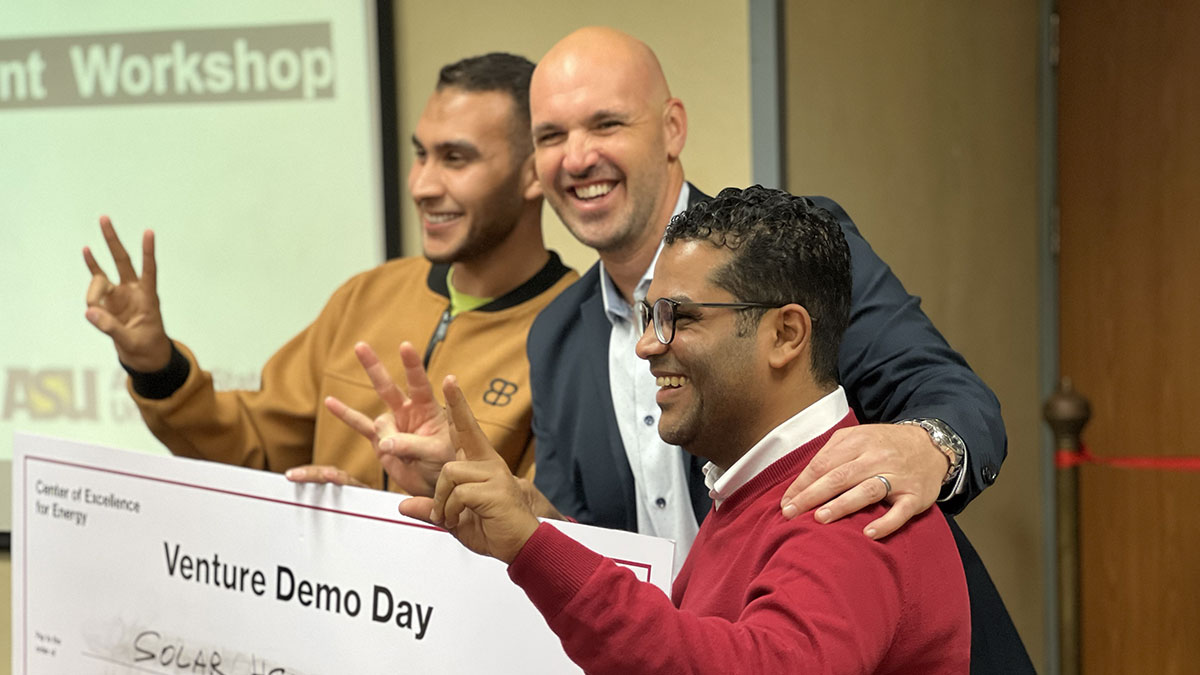
This echoes broader trends. The U.S. Department of Energy’s 2025 Hydropower and Marine Energy Collegiate Competitions engaged 36 teams in water-based solutions, fostering skills in renewable tech[3][4]. In Egypt, ASU’s seed funding supported six renewable projects, including agricultural tech with fog elements[2]. Globally, the Student Energy Solutions Movement has raised $2.5 million toward $10 million for youth projects[1].
Real-time sentiment on social media reflects enthusiasm: Posts praise Nebulavolt for enhancing safety and eco-friendliness, with experts calling for talent development in Pakistan’s energy sector[7]. However, some critiques note funding biases toward “silly apps” over critical tech like renewables[8], urging balanced investment.
Real-World Applications and Impacts
Deployed on fog-prone highways, Nebulavolt could reduce accidents by powering lights and signals, potentially saving lives in South Asia’s deadly winters[[1]](https://www.muslimnetwork.tv/south-asias-deadly-fog-meets-a-student-led-solution-from-pakistan)[9]. Economically, it lowers energy costs for infrastructure, supporting smart cities[6]. Environmentally, it promotes clean energy, aligning with events like Samsung’s Solve for Tomorrow 2025, which encourages student sustainability projects[6].
Broader impacts include community empowerment. In regions like India and Pakistan, similar innovations inspire local adoption, as seen in Galgotias University’s wind-solar hybrid for water and energy[10]. Analysis shows these projects bridge urban-rural divides, but scalability requires policy support—governments must incentivize testing to overcome deployment hurdles.
A balanced perspective acknowledges challenges: Initial costs, though low, may deter adoption in low-income areas, and climate variability could affect reliability. Yet, constructive solutions lie in partnerships, such as integrating with hydropower competitions to refine designs[3].
Expert Opinions and Global Context
Experts on social media view fog-to-energy as a niche but promising field. Journalists highlight its role in addressing South Asia’s fog hazards[11], while energy researchers stress human capital building, like Pakistan’s Margalla School[7]. Academic courses at Stanford explore related energy-climate intersections[8], validating student contributions.
Globally, initiatives like IEEE events on energy tech[5] and CSU’s physics outreach[9] foster innovation. Critiques point to talent gaps in renewables[8], but optimism prevails with funding growth[1]. Actionable paths include expanding competitions and seed grants[2] to nurture more Nebulavolt-like projects.
Challenges and Balanced Analysis
Despite promise, fog-to-energy faces technical hurdles: Low energy density limits large-scale use, and environmental factors like pollution can foul systems. Socially, gender barriers in STEM persist, though Nebulavolt’s all-female team challenges norms. Economically, funding disparities favor established tech over grassroots ideas[8].
A critical analysis reveals strengths in accessibility—devices like Nebulavolt require minimal infrastructure—but weaknesses in consistency. Balanced views from experts suggest hybridization with solar or wind for reliability[[2]](https://www.researchgate.net/publication/388837595_Bioinspired_Dual-Function_Device_Integrating_Fog_Harvesting_and_Hydro-To-Electricity_Conversion_for_Sustainable_Supply_of_Freshwater_and_Electricity). Solutions involve interdisciplinary research, as in ASU’s Egypt program[2], to enhance viability.
Future Prospects and Scalability
Looking ahead, fog-to-energy could expand to coastal or mountainous areas with high mist levels. Students plan refinements for hybrid functionality[[1]](https://www.muslimnetwork.tv/south-asias-deadly-fog-meets-a-student-led-solution-from-pakistan), potentially integrating with marine energy competitions[4]. Global scaling requires investment, with movements like Student Energy providing models[1].
Actionable paths include policy advocacy for subsidies and educational reforms to include fog tech in curricula[8]. By amplifying student voices, these innovations pave the way for resilient, equitable energy systems.
Conclusion
Fog-to-energy solutions, exemplified by student-led projects like Nebulavolt, offer hope amid climate challenges, transforming hazards into resources. Perspectives from experts and global initiatives underscore the need for sustained support to overcome barriers. Constructive solutions lie in funding, education, and collaboration, empowering youth to drive change. Readers are encouraged to support local competitions, advocate for renewable policies, and explore STEM opportunities—collective action can illuminate a sustainable future.
Key Figures
- One result references a “giant fog-filled balloon” used in a physics outreach event[9]
- Another mentions “fog in agriculture” as part of an agricultural technology project[2] There are no scientific studies, technological developments, recent news articles, or recognized initiatives specifically focused on converting fog into energy through student-led projects in the provided search results. What the search results do contain are several legitimate student-led clean energy initiatives from 2024-2025:
- The Student Energy Solutions Movement, which aims to fund 10,000 youth-led clean energy projects globally with $10 million in capital (currently at $2.5 million)[1]
- The U.S. Department of Energy’s 2025 Hydropower and Marine Energy Collegiate Competitions, engaging 36 student teams in water power solutions[3][4]
- An ASU-operated seed funding program for renewable energy projects in Egypt[2] If you’re interested in student-led renewable energy initiatives, fog harvesting technology, or water-based energy solutions, I can provide information based on these documented programs. Alternatively, if you have specific sources or clarification about the “Fog-to-Energy Solution” you’re researching, I’d be happy to search for that information.