

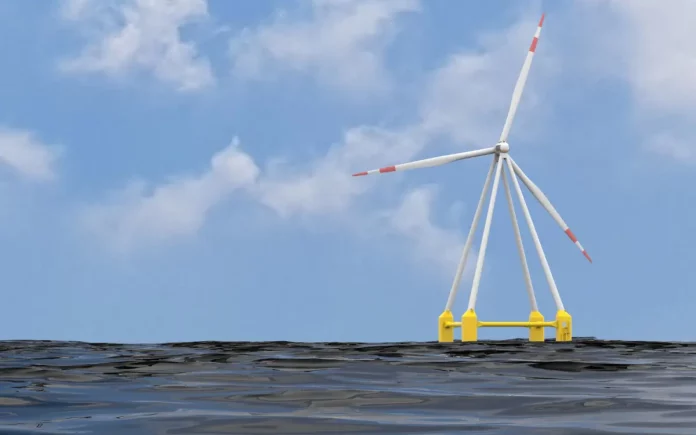


What is floating wind?
Offshore wind energy is divided into two types: fixed offshore wind and floating wind. For fixed offshore wind, wind turbines are anchored on a foundation fixed to the seabed, typically a steel piling weighing up to 2000 tons and penetrating 30 meters into the ground. On the other hand, a floating wind turbine, as its name suggests, rests on a float. These structures are made of steel or concrete and use Archimedes’ principle to stay on the surface. To prevent them from drifting, they are moored to the sea floor with anchoring lines.
Eolink: A key player in floating wind
Eolink is a key player in the field of floating wind, a mature and very competitive technology. The price of electricity from the latest projects awarded in France in 2023 is around 45€/MWh. The costs of this technology follow the same trajectory as those of fixed wind, but without yet benefitting from its accumulated experience. Therefore, cost reduction is a major challenge for floating wind.
Existing and upcoming installations
Eolink is about to revolutionize the energy industry with installations of floating wind in France and Europe. In France, pilot projects are already being developed, particularly in Brittany and the Mediterranean. With the company’s ambition to develop this technology on a large scale, we can expect to see more and more Eolink installations in European waters in the near future.
For greater energy independence
Fixed wind and floating wind are complementary. Fixed wind has paved the way by exploiting shallow seas. Floating wind allows for the exploitation of vast marine areas with depths greater than 60 meters, where 80% of offshore wind resources are found.
A massive energy source
Floating wind is capable of producing 50% of the annual French electricity consumption by exploiting only 2% of the available surface area (the Exclusive Economic Zone) in metropolitan France.
An energy source suitable for the electricity grid
As marine winds are stronger and more constant than on land, floating wind allows for a more regular energy production than photovoltaic or terrestrial wind. In conclusion, Eolink and floating wind represent a major advance in the fight against climate change. This revolutionary technology promises not only greater energy independence, but also a massive contribution to the transition to a green economy.
#FloatingWind #Eolink #InnovationAndGreenTech #planetkeeper #keeperface.


